Primal Geometry
LIFE
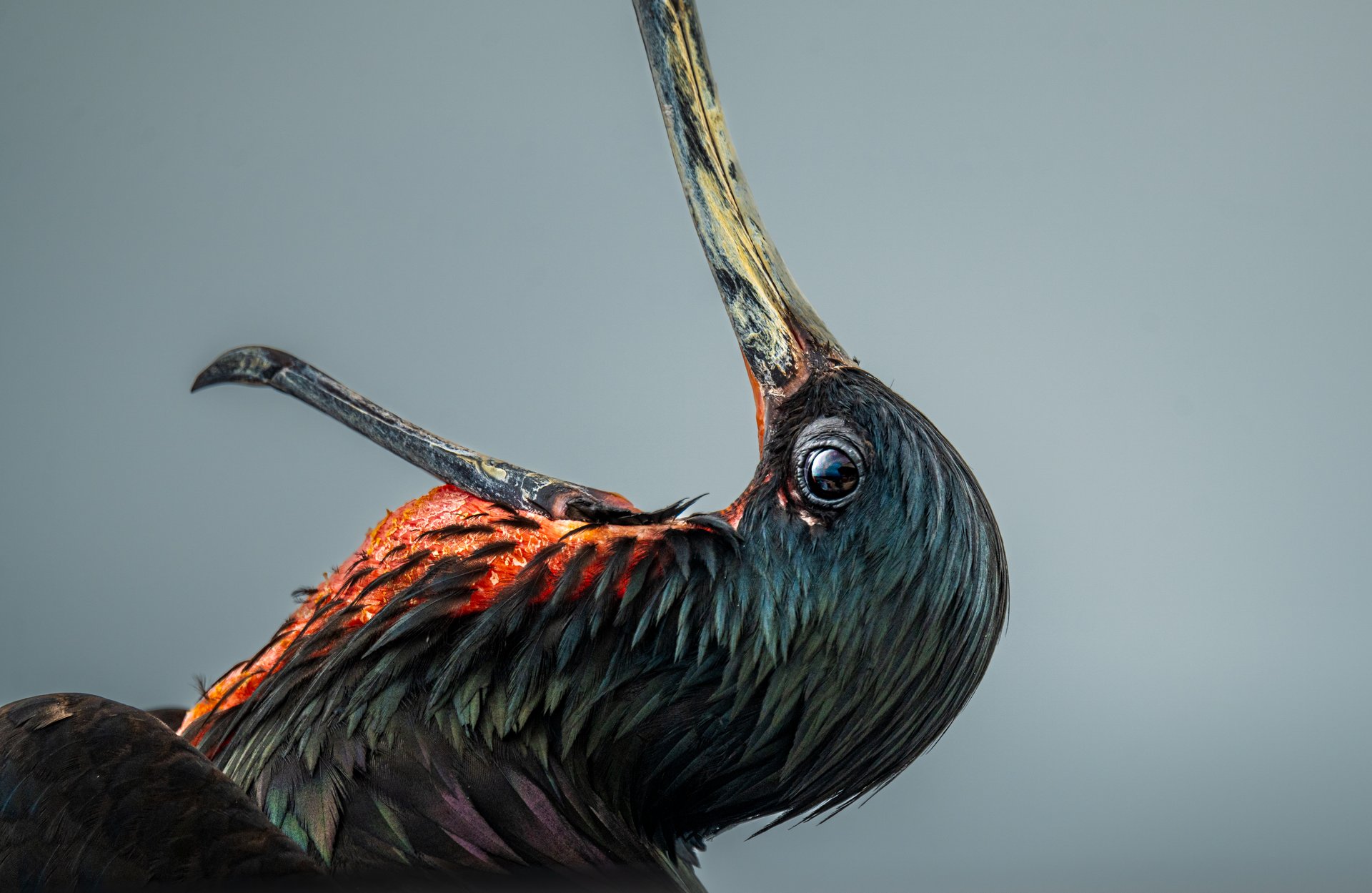
The composition strips away everything except the bird. No perch, no water, no horizon — only a flat expanse of grey that could be sky or could be nothing at all, and against it, the frigatebird's head and neck thrown back into an arc so extreme it edges toward abstraction.
The beak supplies the frame's only true diagonal: a long, weathered length of keratin, its surface cracked and striated like driftwood, cutting from the top edge down toward the bird's eye. Everything else answers to it. The neck folds back beneath that line, and at the throat, color interrupts the black — a raw patch of orange-red skin, exposed where the feathers part, reading almost like a wound against the cold surrounding tone. It's the one warm note in an otherwise tonal image, and it pulls the eye before the bird's own eye does, which watches from the edge of the frame, small, dark, and entirely unreadable.
Stay with the feathers long enough and the black stops being black. Bottle-green surfaces at the crown, a dull bronze along the shoulder, a faint violet where light grazes the barbs at just the right angle. This isn't pigment — it's structural color, produced by the physical architecture of the feather rather than any dye in it, which is why it behaves like oil on water: visible only from certain angles, absent from others. The photograph happens to catch the one angle where it reads clearest, which is also the angle at which the bird looks least like an animal and most like something forged.
Between One Moment and the Next
EARTH
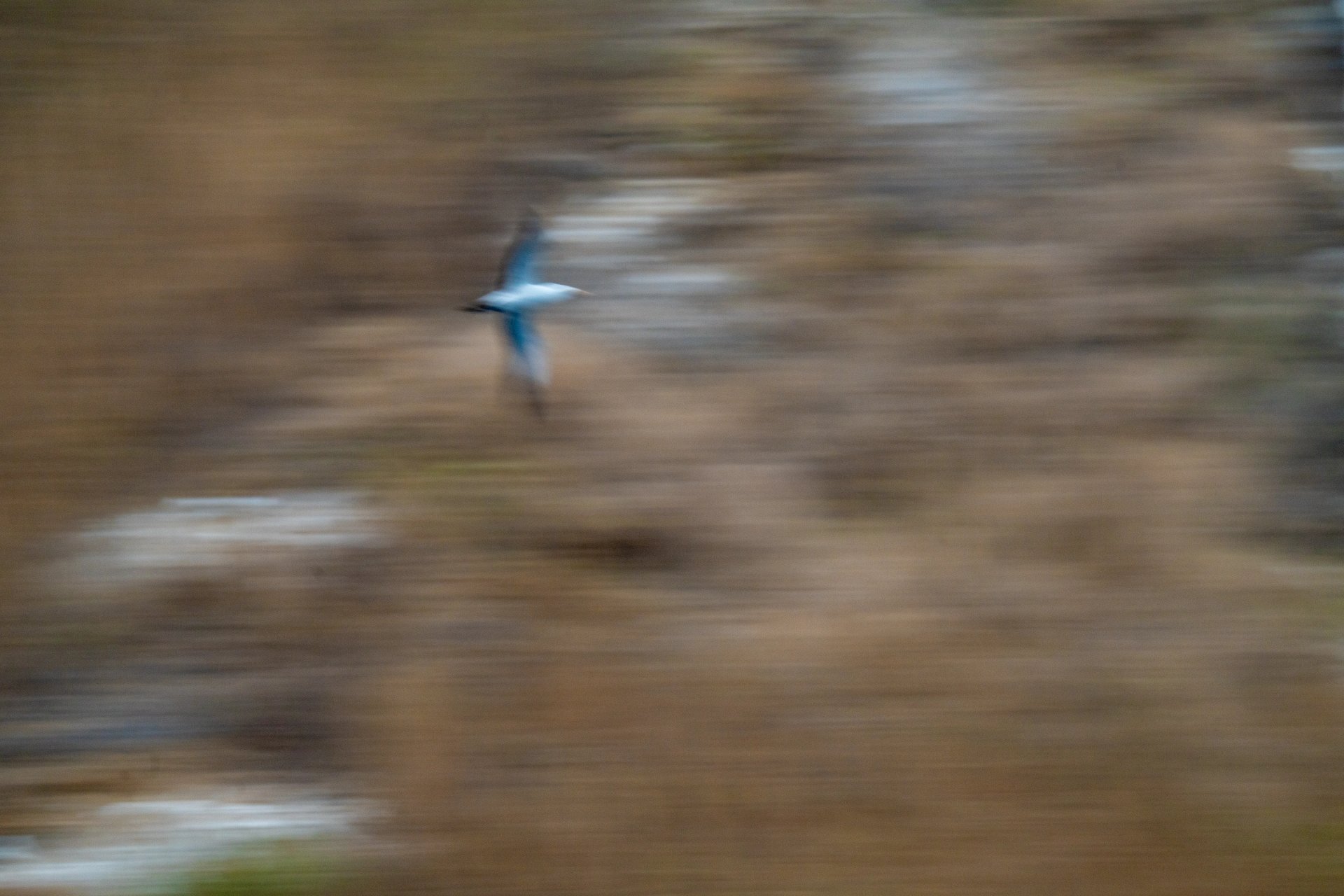
A bird crosses the Galápagos landscape in an instant, its form dissolving into streaks of earth, water and light. Through intentional motion blur, the photograph moves away from conventional wildlife representation. What remains is not a precise record of the bird, but an impression of its passage—a fleeting presence suspended between two moments.
The landscape becomes fluid, almost painterly, while the bird appears as a fragment of movement within it. The image asks what photography can reveal when it stops trying to freeze time and instead allows time to become part of the photograph.
Hidden in Plain Sight
LIFE
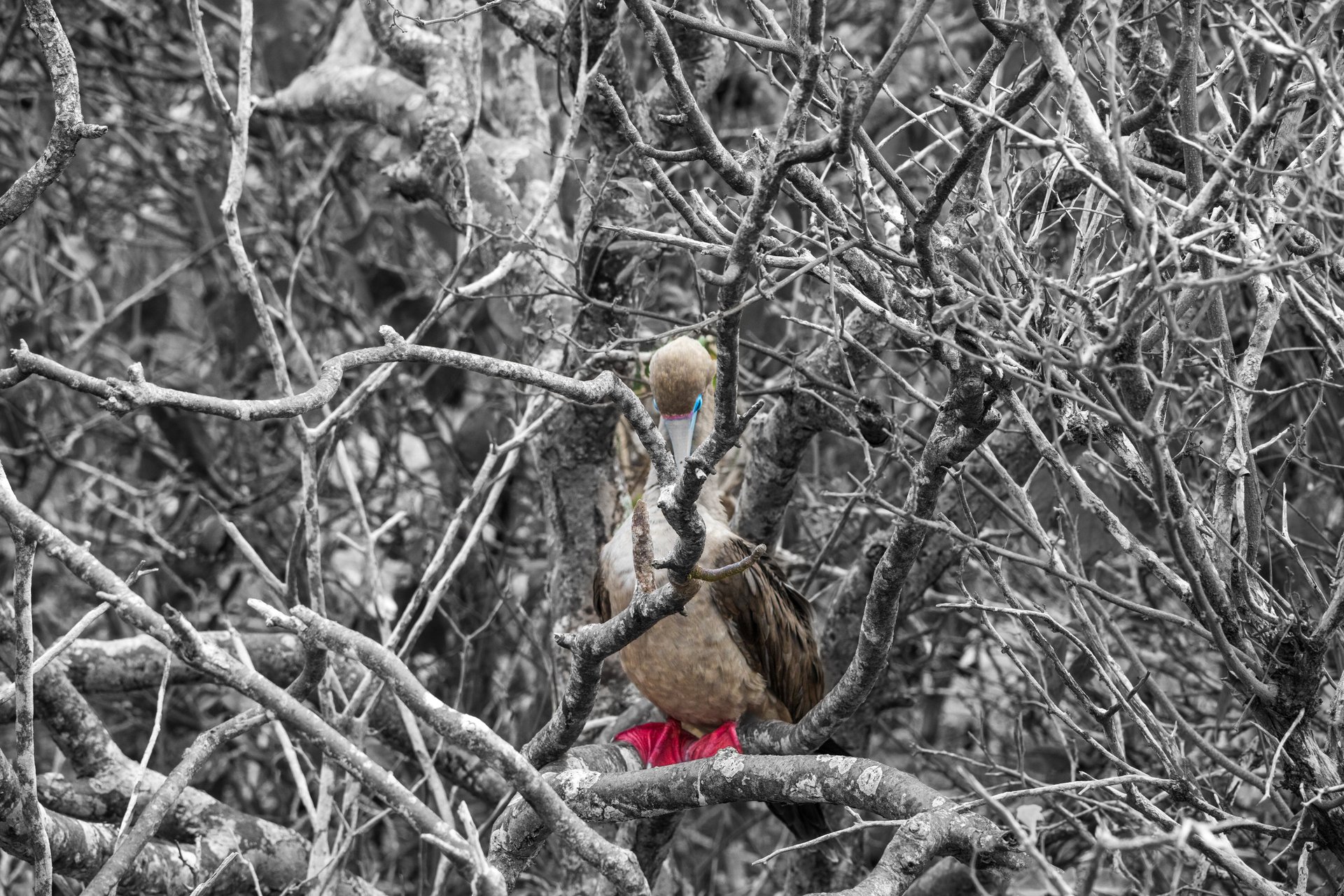
eep within the tangled vegetation of the Galápagos, a red-footed booby is almost completely absorbed into a labyrinth of branches, its body emerging only gradually from the surrounding complexity.
Rendered largely in monochrome, the photograph reduces the forest to an intricate study of line, texture and form. Against this muted world, flashes of red and blue remain—small traces of color that reveal the bird's presence without surrendering the mystery of its surroundings.
Rather than isolating wildlife from its environment, the image asks us to look more carefully at the relationship between the animal and the world that conceals it. The bird is not simply inhabiting the forest; it is part of its visual language.
Galápagos Buddies
EARTH
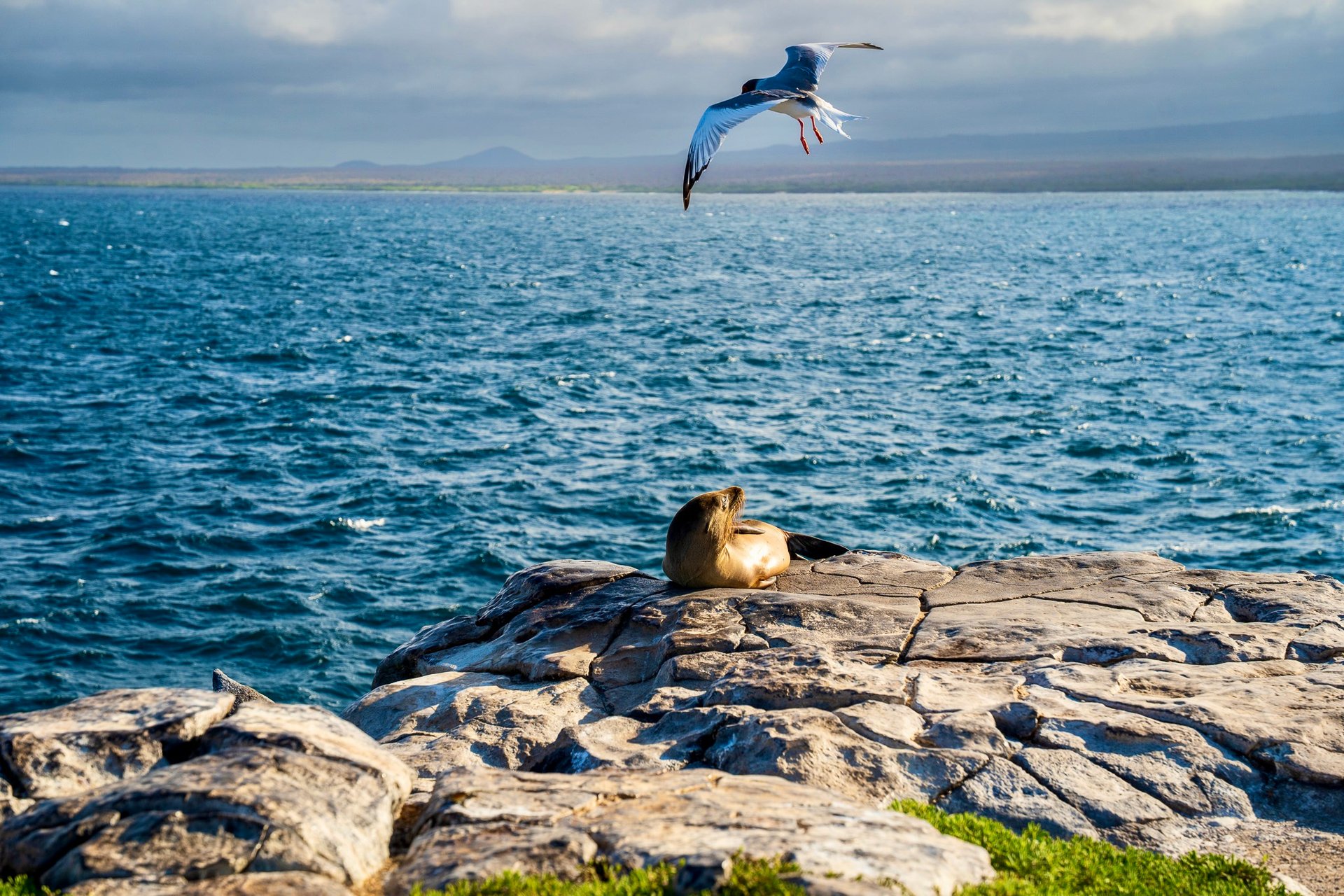
On an ancient, sun-sculpted platform of weathered volcanic stone, a single Galápagos sea lion, sleek and resilient, surrenders to the warm embrace of the equatorial sun. Its presence is a testament to millenia of adaptation on these isolated islands. Overhead, a Swallow-tailed Gull—an avian specter of the dark ocean night—is frozen in a dynamic, low-altitude arc, a graceful counterpoint of flight to the sea lion's terrestrial repose. This image distills the essence of the islands: the coexistence of stillness and movement, of ancient land and ever-shifting water, preserving a fleeting moment of primal harmony.
Volcanic Sentinel
EARTH
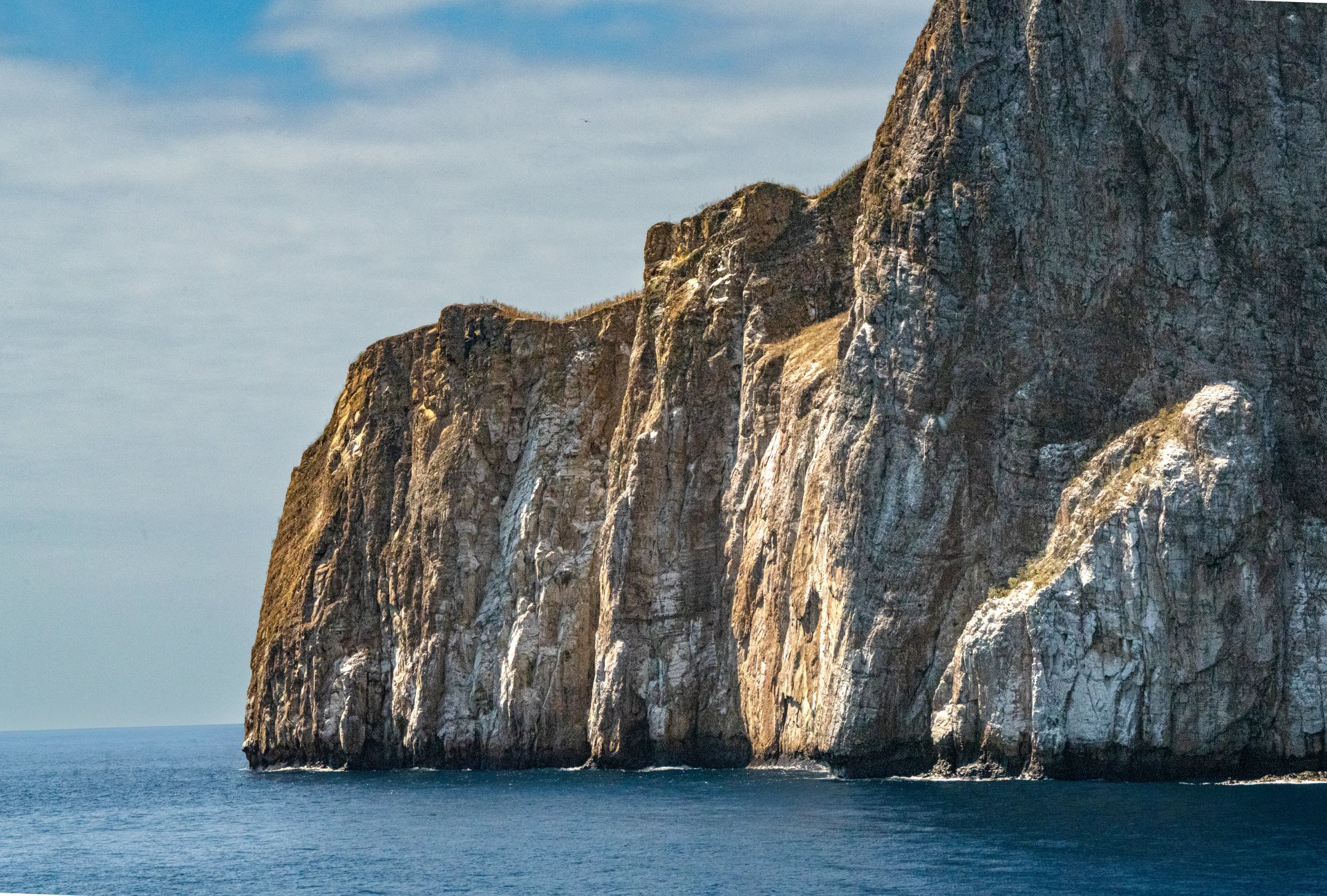
A monolithic presence at the edge of the world. This work captures the sheer, volcanic cliffs of the Galapagos Islands, illuminated by fleeting golden light. It is an exploration of isolation, monumental scale, and the stark beauty of earth’s primordial landscapes. It is a study in harsh contrasts: the unyielding weight of the cliff against the fluid, shifting surface of the sea.
Guardian of the Lava Coast
EARTH
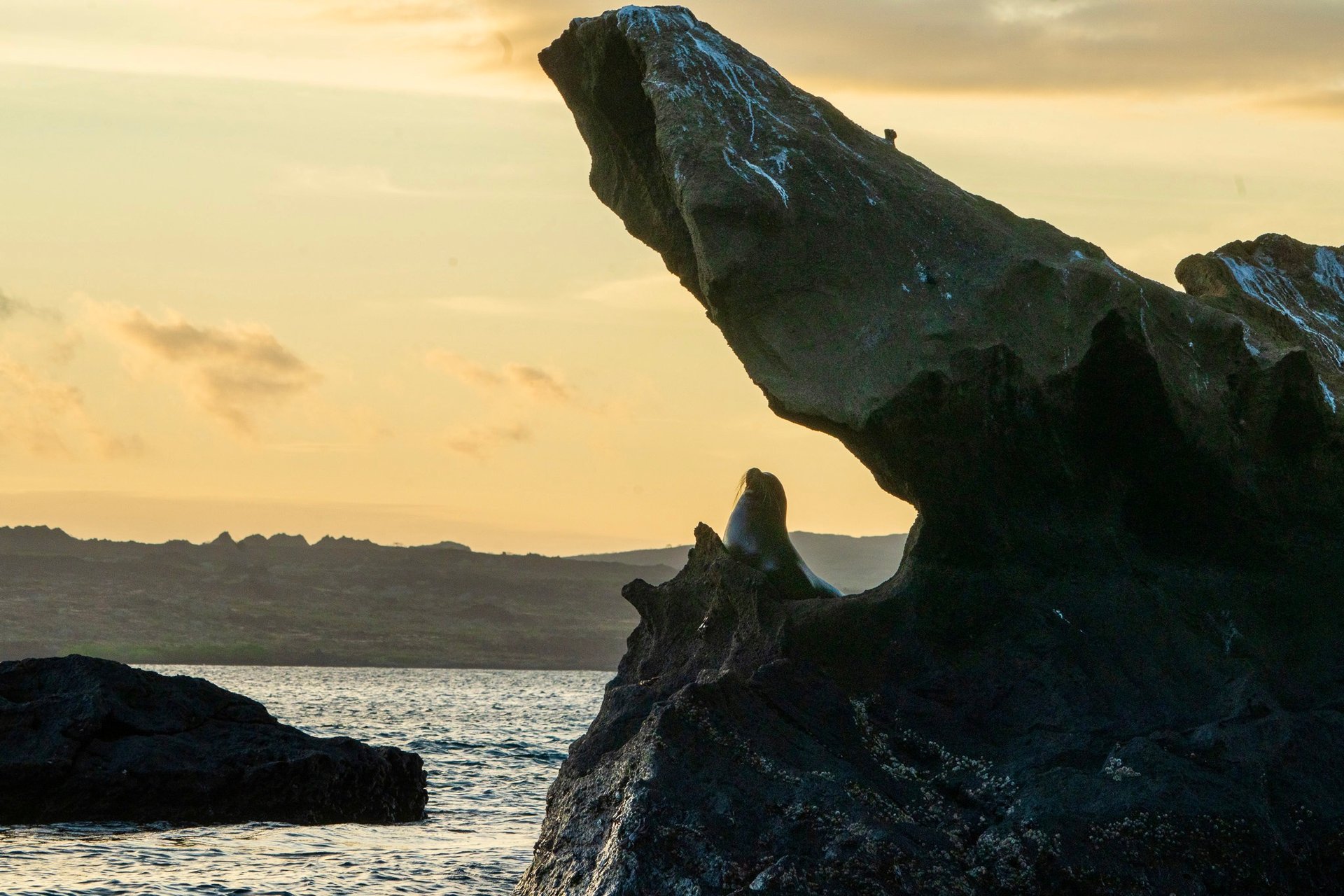
The image captures both the geological drama and quiet wildlife moments the Galápagos is famous for. Photographed on a trip to the Galápagos Islands, this landscape shot captures a Galápagos sea lion perched on a jagged lava rock formation, silhouetted against a glowing golden sunset sky. A dramatic, overhanging volcanic arch looms above the sea lion, framing the scene and emphasizing the raw, sculptural terrain characteristic of the islands' coastline
Despite their relaxed shoreline demeanor, Galápagos sea lions are highly skilled hunters, capable of diving over 600 feet and holding their breath for several minutes while chasing sardines and other schooling fish.
Sea lions live in noisy, tight-knit colonies led by a dominant bull who fiercely defends his territory and harem — the deep barking calls heard on Galápagos beaches are part of this constant social negotiation.
Because they rely heavily on cold, nutrient-rich waters for fish stocks, Galápagos sea lion populations are notably sensitive to El Niño events, which can cause sharp, temporary population declines.
A Splash of Gold on Black Lava: The Galápagos Yellow Warbler
LIFE
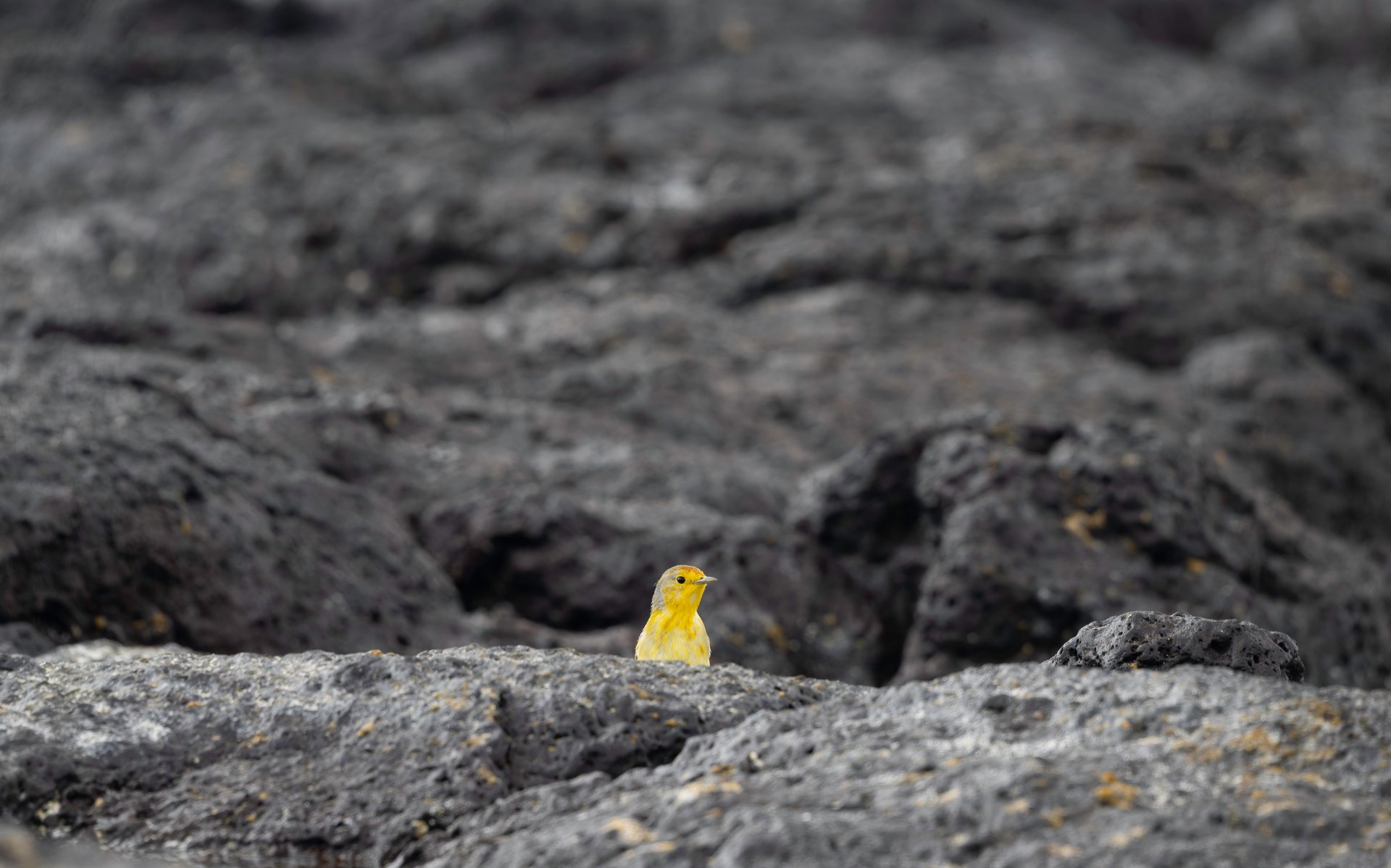
Photographed on a wildlife trip to the Galápagos Islands, this image captures a Galápagos yellow warbler (Setophaga petechia aureola) perched delicately amid a vast field of dark volcanic lava rock. The tiny bird's brilliant yellow plumage and rust-colored cap create striking contrast against the stark, textured grey and black terrain — a visual reminder of how life finds a foothold even in the islands' harshest volcanic landscapes. The composition's negative space and shallow depth of field emphasize the warbler's small scale against the immensity of the lava field, a hallmark scene of Galápagos's rugged beauty.
Stone and Scale
LIFE
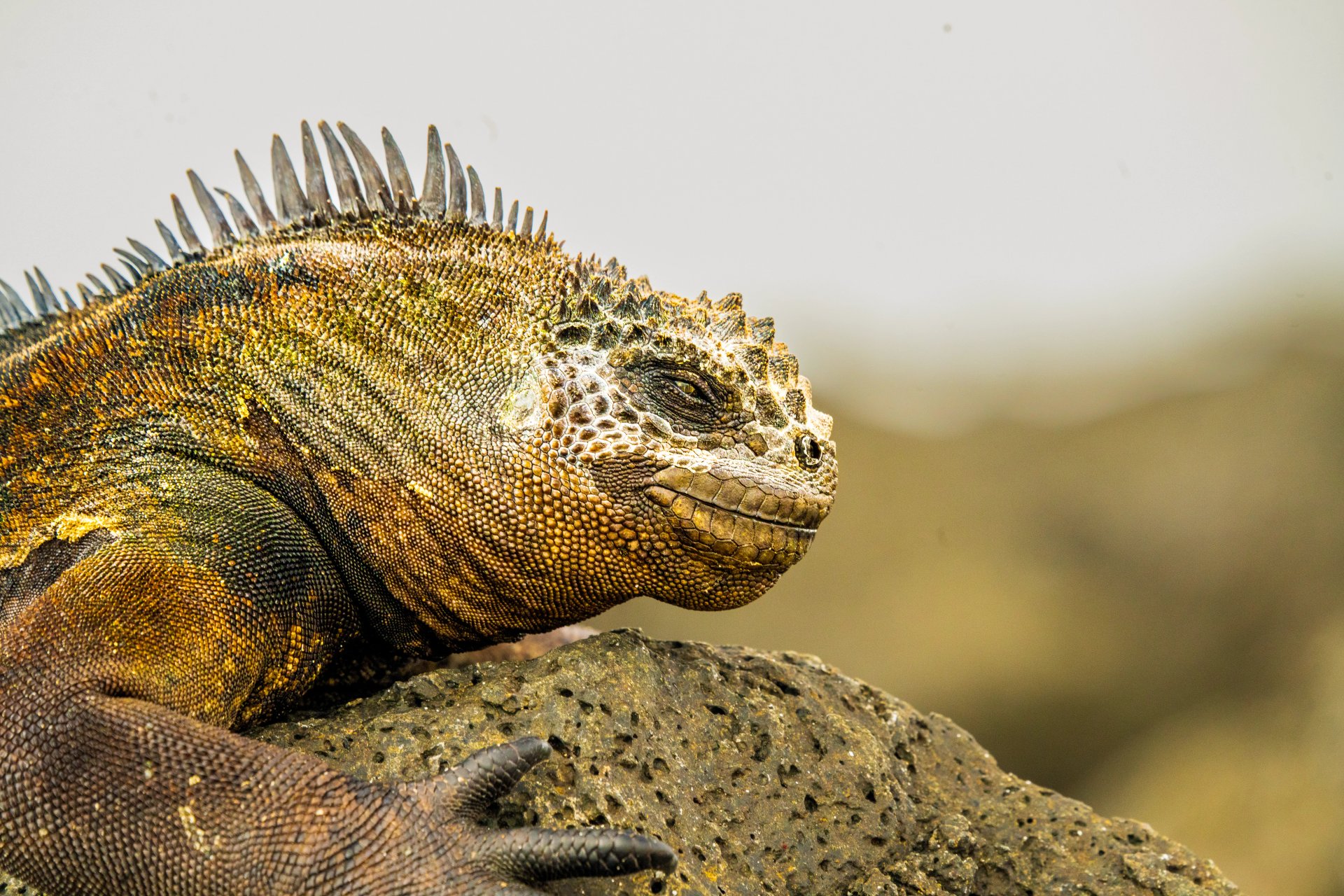
A Galápagos land iguana rests upon volcanic rock, its weathered skin and serrated crest echoing the raw geology of the islands around it. In this close portrait, the distinction between animal and landscape seems to narrow—scales resemble stone, muted earth tones mirror the volcanic terrain, and a form shaped by evolution appears almost carved from the island itself.
Found only in the Galápagos, the land iguana belongs to a lineage whose isolation allowed it to evolve alongside one of the world's most unusual ecosystems. Its formidable appearance belies an animal adapted to a sparse terrestrial environment, feeding largely on vegetation and obtaining much of the moisture it needs from plants such as cactus.
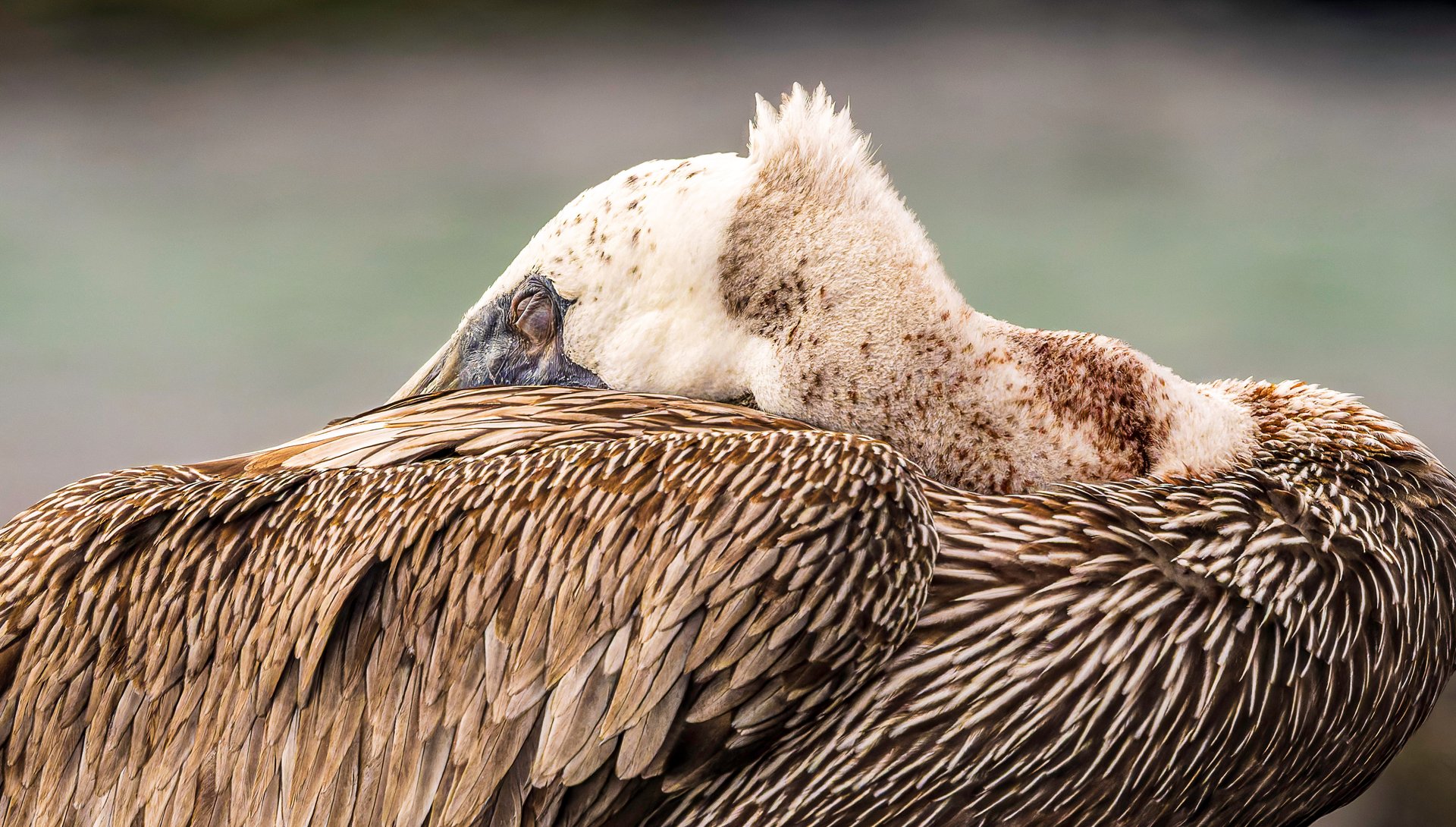
Brown Pelican: Ruffled and at Peace
LIFE
The Galápagos brown pelican is larger and darker than its North American cousins, having adapted over generations of isolation.Pelicans are among the oldest bird groups alive — fossil evidence suggests pelican-like birds existed over 30 million years ago, largely unchanged in basic form.
Brown pelicans are the only pelican species that plunge-dives from the air (often 20–60 feet up) to catch fish, folding their wings and hitting the water like a torpedo. Air sacs beneath their skin cushion the impact. A pelican's gular pouch can hold up to 3 gallons of water — roughly three times the capacity of its stomach. After a dive, it drains the water before swallowing the fish.
The tufted, sometimes wild-looking crest feathers (visible in this photo) are often more pronounced during breeding season, when pelicans also develop brighter pouch and neck coloring.
Pelicans often tuck their heads back against their bodies (as seen here) both to sleep and to regulate body temperature, since it reduces heat loss through the bill and neck.
Brown pelicans were nearly wiped out in the mid-20th century due to DDT pesticide poisoning, which thinned their eggshells. They were removed from the U.S. Endangered Species list in 2009 after a major recovery.