Primal Geometry
LIFE
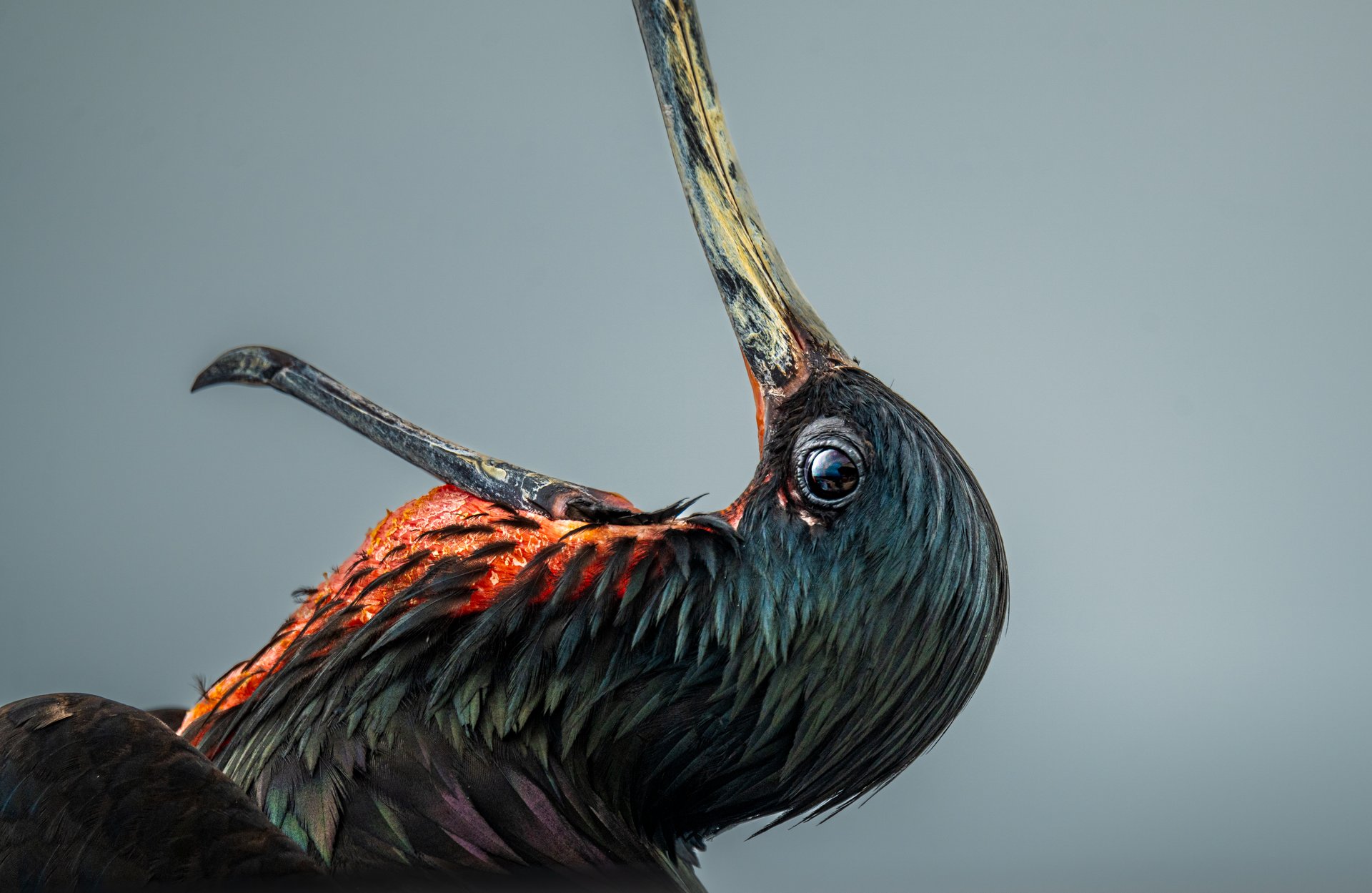
The composition strips away everything except the bird. No perch, no water, no horizon — only a flat expanse of grey that could be sky or could be nothing at all, and against it, the frigatebird's head and neck thrown back into an arc so extreme it edges toward abstraction. The beak supplies the frame's only true diagonal: a long, weathered length of keratin, its surface cracked and striated like driftwood, cutting from the top edge down toward the bird's eye. Everything else answers to it. The neck folds back beneath that line, and at the throat, color interrupts the black — a raw patch of orange-red skin, exposed where the feathers part, reading almost like a wound against the cold surrounding tone. It's the one warm note in an otherwise tonal image, and it pulls the eye before the bird's own eye does, which watches from the edge of the frame, small, dark, and entirely unreadable. Stay with the feathers long enough and the black stops being black. Bottle-green surfaces at the crown, a dull bronze along the shoulder, a faint violet where light grazes the barbs at just the right angle. This isn't pigment — it's structural color, produced by the physical architecture of the feather rather than any dye in it, which is why it behaves like oil on water: visible only from certain angles, absent from others. The photograph happens to catch the one angle where it reads clearest, which is also the angle at which the bird looks least like an animal and most like something forged.