Butterfly Nebula (IC 1318)

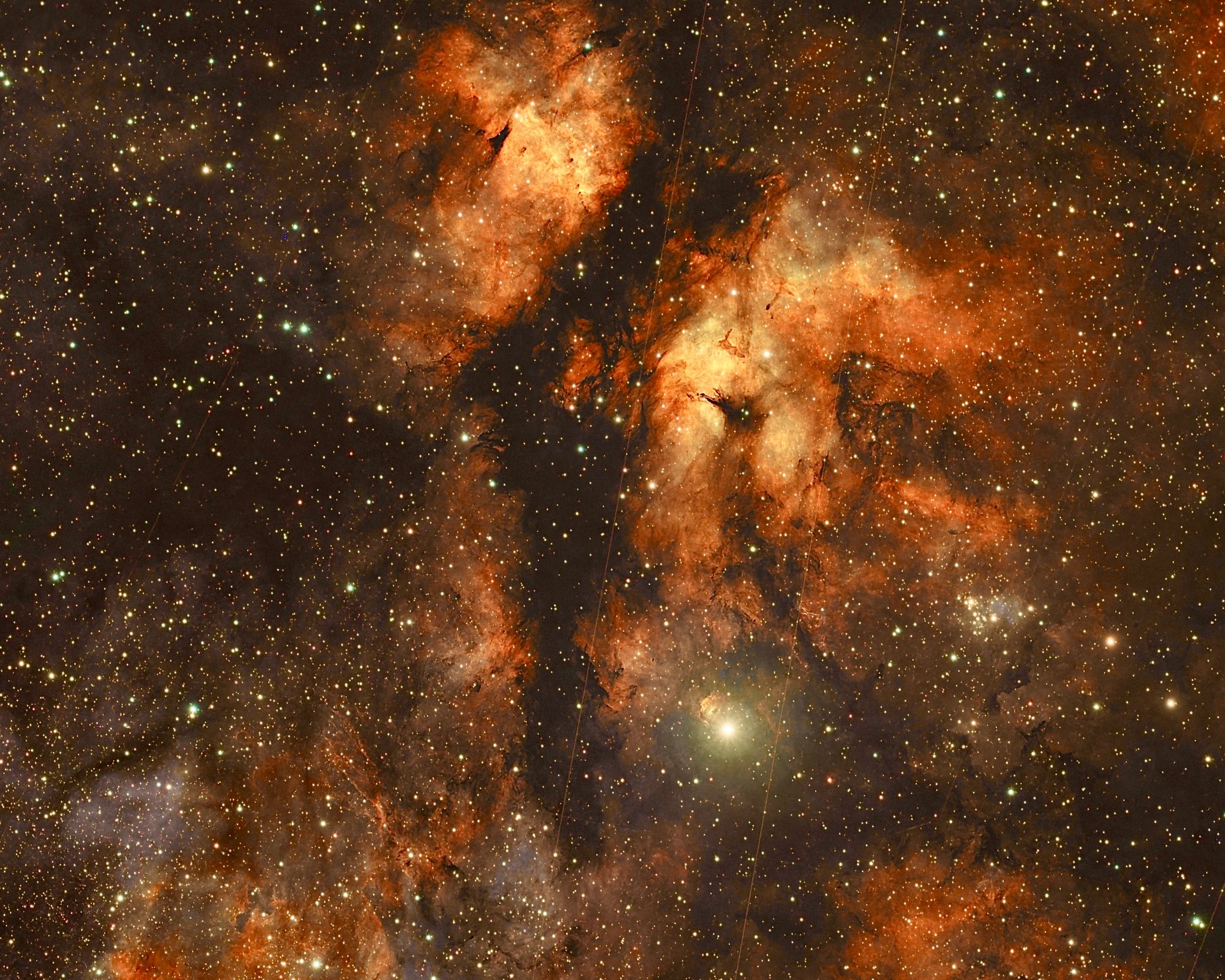
Wide-field astrophotography showing the Gamma Cygni Nebula (IC 1318), the bright star Sadr (Gamma Cygni), and the Dark Dahr Lane LDN 889 surrounded by dense glowing hydrogen emission clouds.

Butterfly Nebula (IC 1318)

COSMOS

IC 1318, commonly known as the Gamma Cygni Nebula or Butterfly Nebula, is located in the northern constellation Cygnus. Brightly illuminated near the center is Sadr (γ Cygni), a supergiant star that anchors the celestial cross of Cygnus. Dividing the two glowing wings of ionized gas is a prominent dark lane of dense interstellar dust, cataloged as LDN 889 (Lynds' Dark Nebula 889). Astrophysical Highlights & Fast Facts Distance & Scale: The IC 1318 nebula complex lies approximately 2,000 to 5,000 light-years from Earth, spanning tens of light-years across the rich star fields of the Milky Way plane. The Illusion of Sadr: Although Sadr (γ Cygni) appears centrally located within the glowing structure, it is actually a foreground star situated roughly 1,800 light-years away—much closer than the emission nebula itself. Emission Mechanism: The vivid orange and warm reddish glow originates primarily from hydrogen gas ionized by high-energy ultraviolet radiation from massive hot stars embedded within the region. Dark Dust Lanes (LDN 889): The dark silhouettes bisecting the nebular wings are cold molecular clouds containing thick interstellar dust that completely blocks background starlight, marking sites of potential future star formation. Cluster Features: Nearby open star clusters, such as NGC 6910, populate this star-dense region, adding fine structural depth to wide-field exposures.

Artist description

IC 1318, commonly known as the Gamma Cygni Nebula or Butterfly Nebula, is located in the northern constellation Cygnus. Brightly illuminated near the center is Sadr (γ Cygni), a supergiant star that anchors the celestial cross of Cygnus. Dividing the two glowing wings of ionized gas is a prominent dark lane of dense interstellar dust, cataloged as LDN 889 (Lynds' Dark Nebula 889). Astrophysical Highlights & Fast Facts Distance & Scale: The IC 1318 nebula complex lies approximately 2,000 to 5,000 light-years from Earth, spanning tens of light-years across the rich star fields of the Milky Way plane. The Illusion of Sadr: Although Sadr (γ Cygni) appears centrally located within the glowing structure, it is actually a foreground star situated roughly 1,800 light-years away—much closer than the emission nebula itself. Emission Mechanism: The vivid orange and warm reddish glow originates primarily from hydrogen gas ionized by high-energy ultraviolet radiation from massive hot stars embedded within the region. Dark Dust Lanes (LDN 889): The dark silhouettes bisecting the nebular wings are cold molecular clouds containing thick interstellar dust that completely blocks background starlight, marking sites of potential future star formation. Cluster Features: Nearby open star clusters, such as NGC 6910, populate this star-dense region, adding fine structural depth to wide-field exposures.