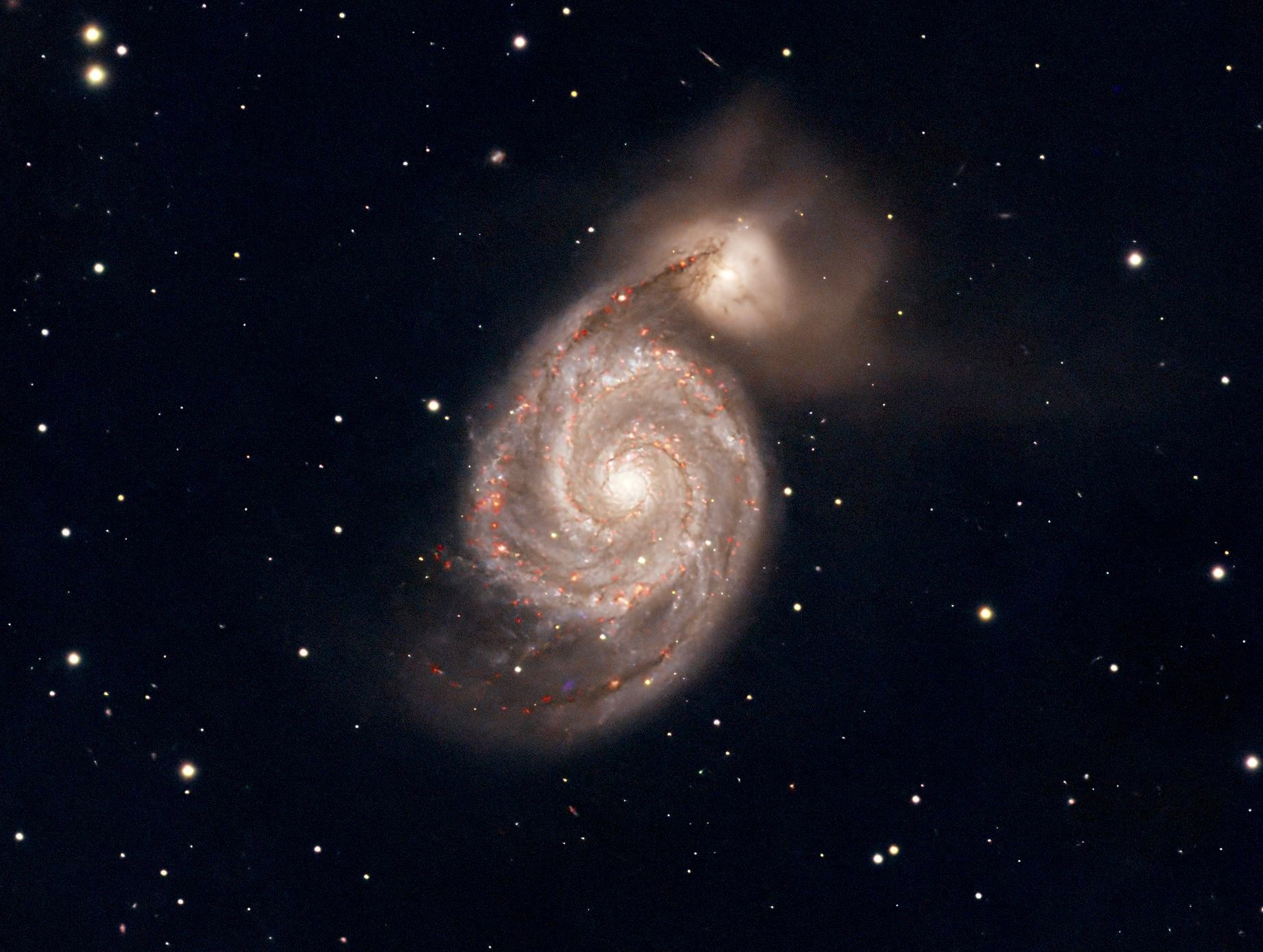
M51 (Whirlpool Galaxy)
COSMOS
M51 was the first astronomical object ever recognized as having a spiral structure when it was observed In 1845. Before this, astronomers thought these objects were just "spiral nebulae" within our own galaxy. The Whirlpool Galaxy is locked in a gravitational dance with a smaller dwarf galaxy, NGC 5195, which appears to be dangling off the end of one of its spiral arms. As NGC 5195 passes behind the larger galaxy, its gravity acts like a "plow," compressing the gas in M51’s disk. This compression triggers massive bursts of star formation, which is why M51’s spiral arms are so exceptionally bright and well-defined. M51 is often used by scientists to study how stars are born. Because we see it nearly face-on, we can see the entire "assembly line": On the inner edges of the arms, dark dust lanes mark where gas is starting to clump together. Bright pink patches are giant clouds of ionized hydrogen where new stars are currently igniting. The outer edges of the arms are lined with brilliant blue clusters of hot, young stars that have recently emerged from their cocoons. While it looks close through a telescope, M51 is roughly 31 million light-years away. It is about 76,000 light-years across—slightly smaller than our Milky Way. It resides in the constellation Canes Venatici (The Hunting Dogs), located just "under" the handle of the Big Dipper.