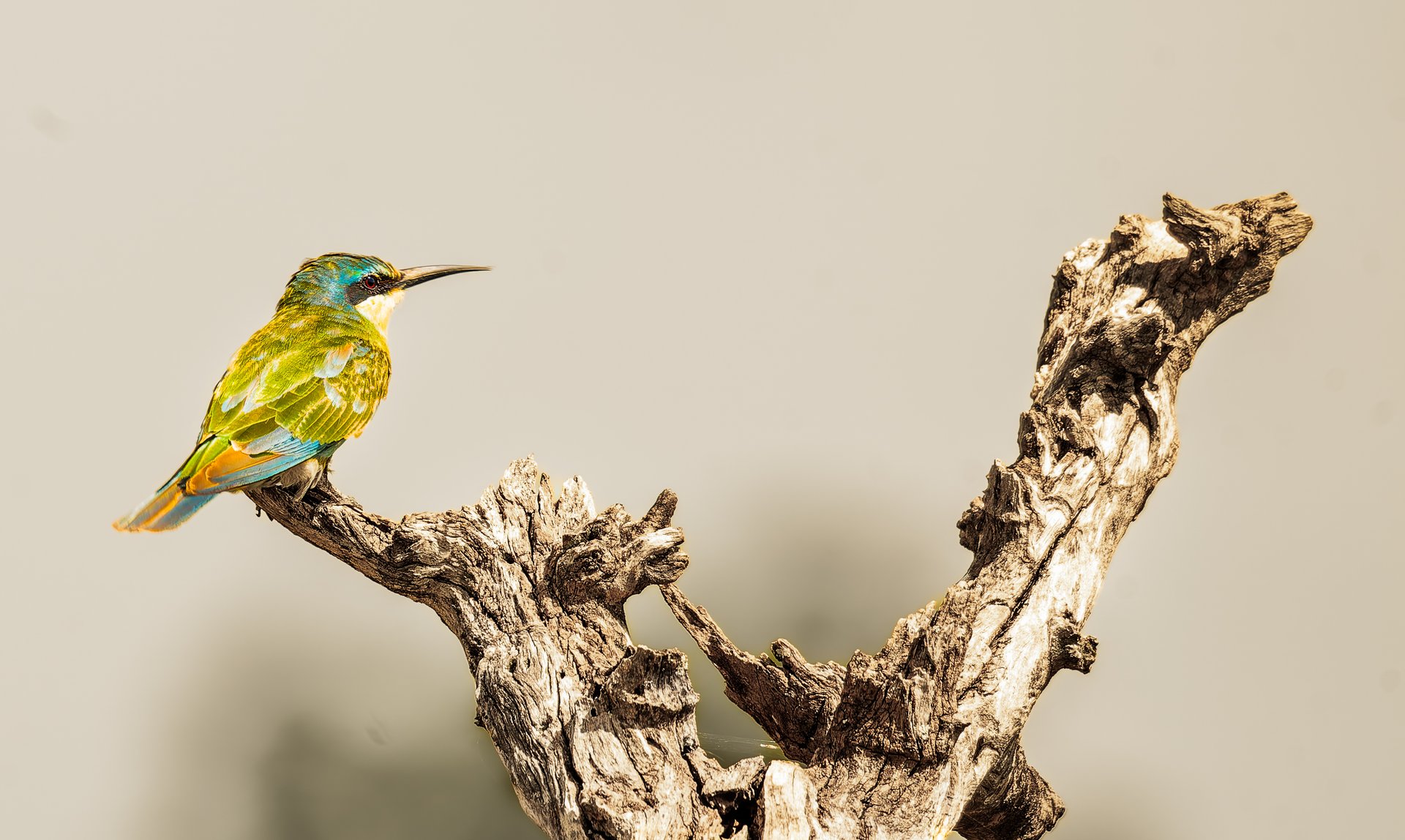
Little Bee-eater (Merops pusillus)

Colorful Little bee eater bird perched on a weathered branch against a neutral background.

Little Bee-eater (Merops pusillus)

LIFE

The Little Bee-eater (Merops pusillus) is a master of the "low-and-slow" hunting style compared to its larger cousins. As its name suggests, this is the smallest bee-eater species in Africa. While the Carmine Bee-eaters (also seen in the gallery) are large and bold, the Little Bee-eater is much more delicate, usually measuring only about 15-17 cm in length. Unlike the Southern Carmine Bee-eater, which nests in massive, noisy colonies of thousands, the Little Bee-eater is a solitary nester. They prefer privacy, digging their own individual nesting burrows into sandy banks or even the abandoned holes of aardvarks or warthogs. While other bee-eaters hunt from high treetops, the Little Bee-eater is a low-perch specialist. It typically perches on low bushes, reeds, or even tall grass—often just a few feet off the ground. From this low vantage point, it snatches small insects like flies and tiny bees that other birds might miss. Despite its small size, it follows the same rigorous safety protocols as the larger African Green Bee-eater. It will never swallow a bee or wasp without first beating it against a branch to discharge the venom and break the stinger.

Artist description

The Little Bee-eater (Merops pusillus) is a master of the "low-and-slow" hunting style compared to its larger cousins. As its name suggests, this is the smallest bee-eater species in Africa. While the Carmine Bee-eaters (also seen in the gallery) are large and bold, the Little Bee-eater is much more delicate, usually measuring only about 15-17 cm in length. Unlike the Southern Carmine Bee-eater, which nests in massive, noisy colonies of thousands, the Little Bee-eater is a solitary nester. They prefer privacy, digging their own individual nesting burrows into sandy banks or even the abandoned holes of aardvarks or warthogs. While other bee-eaters hunt from high treetops, the Little Bee-eater is a low-perch specialist. It typically perches on low bushes, reeds, or even tall grass—often just a few feet off the ground. From this low vantage point, it snatches small insects like flies and tiny bees that other birds might miss. Despite its small size, it follows the same rigorous safety protocols as the larger African Green Bee-eater. It will never swallow a bee or wasp without first beating it against a branch to discharge the venom and break the stinger.