Dumbbell Nebula (M 27)

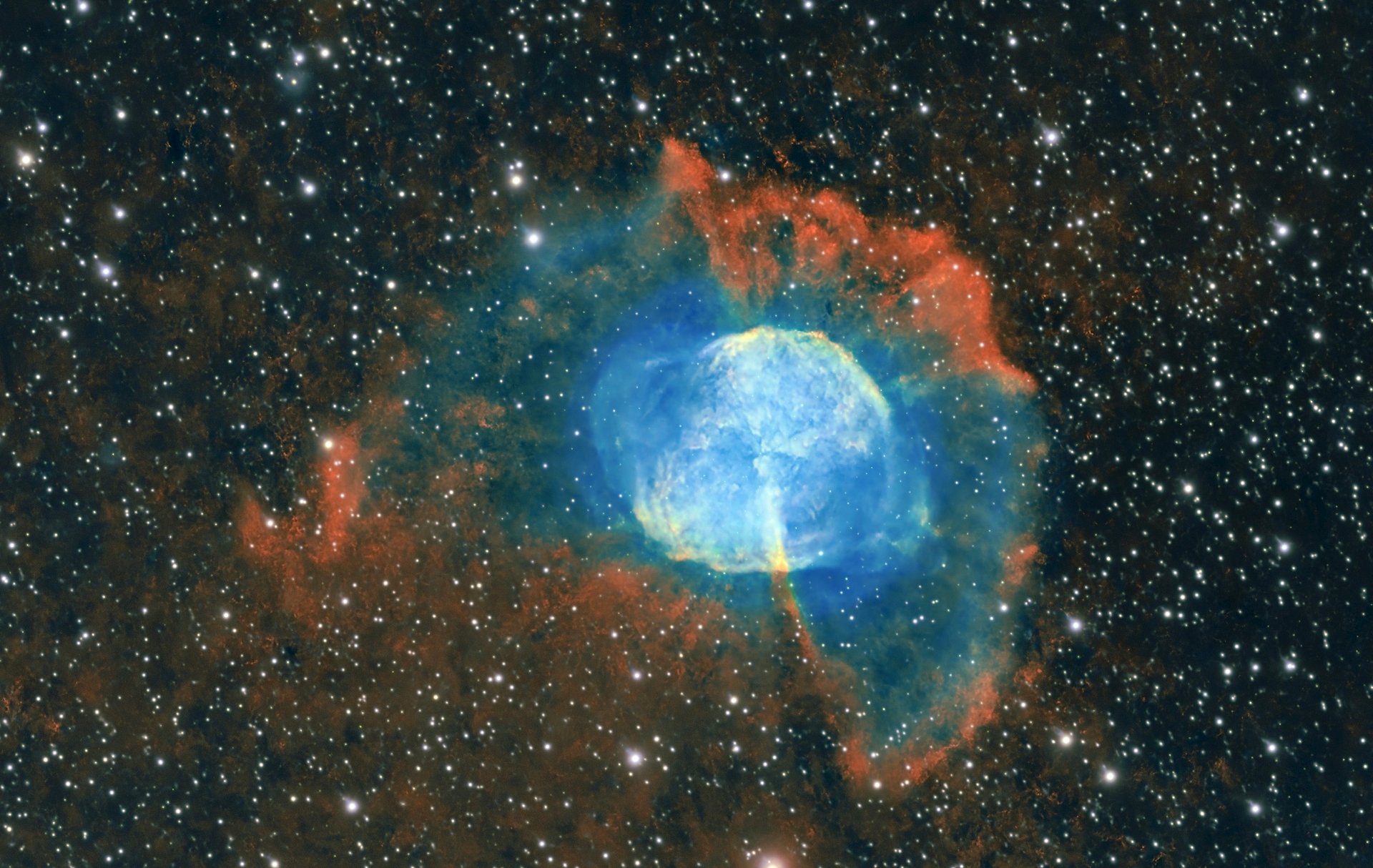
Deep-sky astrophotograph of M27, the Dumbbell Nebula (NGC 6853), showing its bright blue-green oxygen-rich interior, red hydrogen emission, extended outer shell and dense star field in Vulpecula.

Dumbbell Nebula (M 27)

COSMOS

M27, better known as the Dumbbell Nebula or NGC 6853, is one of the most famous planetary nebulae in the night sky. Located approximately 1,200 light-years from Earth in the constellation Vulpecula, this object is the expanding remains of a dying star. Despite its name, a planetary nebula has nothing to do with planets. The term dates to the early days of telescopic astronomy, when some of these compact, round objects looked vaguely planet-like. M27 was discovered by Charles Messier in 1764 and became the first planetary nebula ever identified. M27 represents a late stage in the evolution of a star that began its life with a mass not dramatically different from that of the Sun. As the star aged, it expanded and eventually expelled its outer layers into space. The exposed stellar core remains at the center as an extremely hot white dwarf. In other words, this beautiful nebula is essentially a stellar death scene—and a preview of the distant future of our own Sun. The glowing shell will continue expanding and dispersing into interstellar space. Eventually the nebula will fade, leaving behind the hot white-dwarf remnant at its center. What we see today is therefore a brief chapter in the life of a star—a structure that exists for only a relatively short period on astronomical timescales. Planetary nebulae form their shape through interacting stellar winds — a slow, dense wind shed during the red giant phase gets overtaken and sculpted by a much faster, thinner wind blown later by the exposed hot core, carving the gas into shells, hourglasses, or bipolar lobes like the one in your image. Emission-line chemistry: The blue-teal comes specifically from oxygen atoms that have lost two electrons (OIII, 500.7 nm) — a very particular ionization state that only exists near extremely hot, energetic sources. It's essentially a fingerprint of the white dwarf's temperature. The lifespan is short (cosmically); Planetary nebulae are one of the most fleeting phases in stellar evolution — visible for only about 10,000–20,000 years before the gas disperses too thin to glow. You're catching this star at a very specific, temporary moment. The end state: The central white dwarf doesn't explode — it just cools, slowly, over many billions of years, eventually (in theory) becoming a cold, dark "black dwarf." The universe isn't old enough yet for any to exist. One of the most fascinating features is a population of dense knots of gas and dust embedded within the nebula seen faintly in this image. These structures can resemble fingers, globules and comet-like clouds, with some developing tails as material is sculpted by the surrounding stellar wind and radiation. NASA estimates that individual knots can range from approximately 17 billion to 56 billion kilometers across, and some contain a mass comparable to several Earths. These knots occur where hot ionized gas encounters cooler, denser material. M27 is particularly fascinating because it allows us to see the consequences of stellar evolution on a relatively nearby scale. The nebula is only about 1,200 light-years away, meaning that the light recorded in this image began its journey toward Earth roughly twelve centuries ago.

Artist description

M27, better known as the Dumbbell Nebula or NGC 6853, is one of the most famous planetary nebulae in the night sky. Located approximately 1,200 light-years from Earth in the constellation Vulpecula, this object is the expanding remains of a dying star. Despite its name, a planetary nebula has nothing to do with planets. The term dates to the early days of telescopic astronomy, when some of these compact, round objects looked vaguely planet-like. M27 was discovered by Charles Messier in 1764 and became the first planetary nebula ever identified. M27 represents a late stage in the evolution of a star that began its life with a mass not dramatically different from that of the Sun. As the star aged, it expanded and eventually expelled its outer layers into space. The exposed stellar core remains at the center as an extremely hot white dwarf. In other words, this beautiful nebula is essentially a stellar death scene—and a preview of the distant future of our own Sun. The glowing shell will continue expanding and dispersing into interstellar space. Eventually the nebula will fade, leaving behind the hot white-dwarf remnant at its center. What we see today is therefore a brief chapter in the life of a star—a structure that exists for only a relatively short period on astronomical timescales. Planetary nebulae form their shape through interacting stellar winds — a slow, dense wind shed during the red giant phase gets overtaken and sculpted by a much faster, thinner wind blown later by the exposed hot core, carving the gas into shells, hourglasses, or bipolar lobes like the one in your image. Emission-line chemistry: The blue-teal comes specifically from oxygen atoms that have lost two electrons (OIII, 500.7 nm) — a very particular ionization state that only exists near extremely hot, energetic sources. It's essentially a fingerprint of the white dwarf's temperature. The lifespan is short (cosmically); Planetary nebulae are one of the most fleeting phases in stellar evolution — visible for only about 10,000–20,000 years before the gas disperses too thin to glow. You're catching this star at a very specific, temporary moment. The end state: The central white dwarf doesn't explode — it just cools, slowly, over many billions of years, eventually (in theory) becoming a cold, dark "black dwarf." The universe isn't old enough yet for any to exist. One of the most fascinating features is a population of dense knots of gas and dust embedded within the nebula seen faintly in this image. These structures can resemble fingers, globules and comet-like clouds, with some developing tails as material is sculpted by the surrounding stellar wind and radiation. NASA estimates that individual knots can range from approximately 17 billion to 56 billion kilometers across, and some contain a mass comparable to several Earths. These knots occur where hot ionized gas encounters cooler, denser material. M27 is particularly fascinating because it allows us to see the consequences of stellar evolution on a relatively nearby scale. The nebula is only about 1,200 light-years away, meaning that the light recorded in this image began its journey toward Earth roughly twelve centuries ago.