Iris Nebula and Cepheus dust (NGC 7023, LDL 1174)

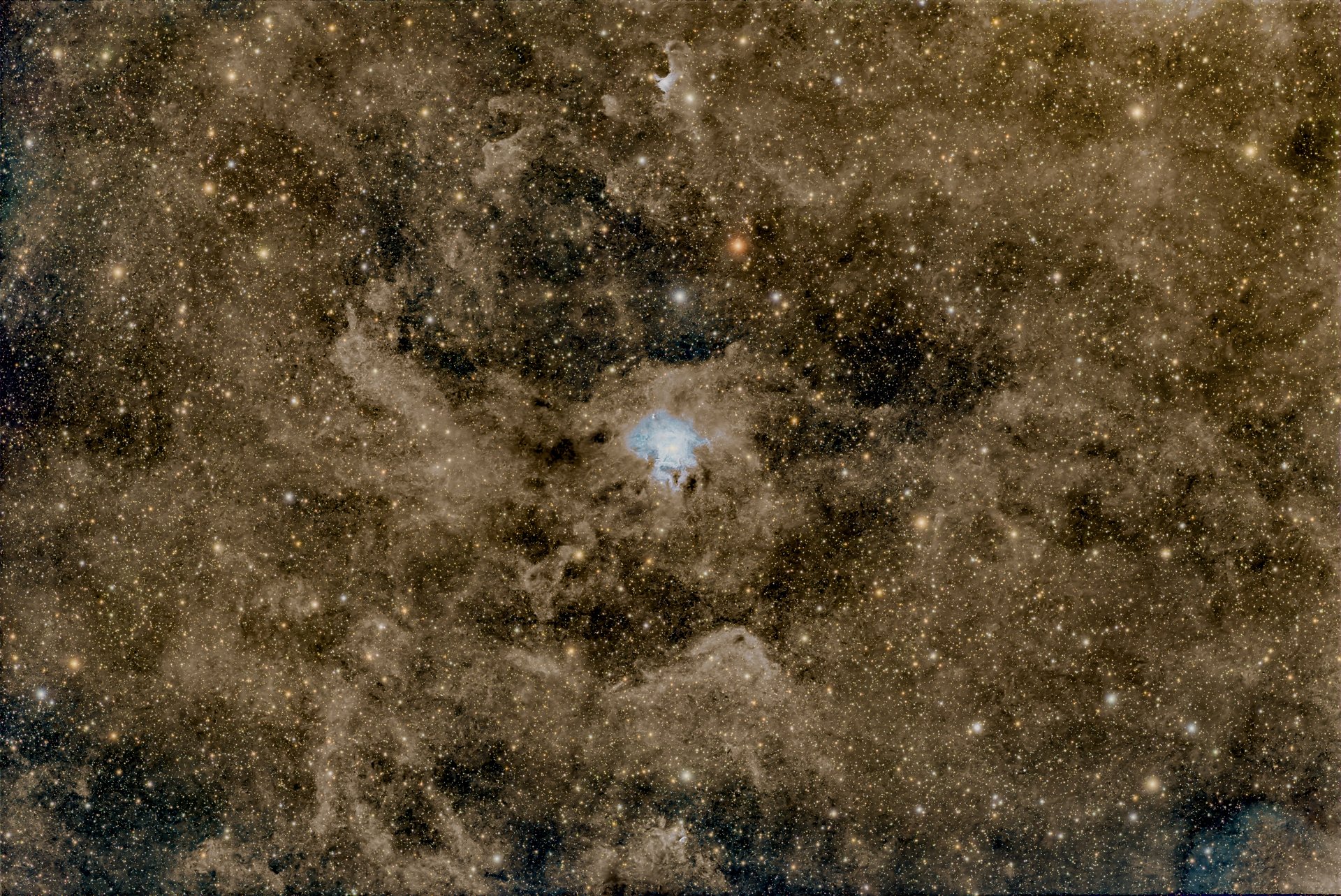
The Iris Nebula NGC NGC 7023, a blue reflection nebula surrounded by brown molecular dust in Cepheus.

Iris Nebula and Cepheus dust (NGC 7023, LDL 1174)

COSMOS

At the center of this image is NGC 7023, the Iris Nebula, one of the most recognized reflection nebulae in the northern sky. Its blue glow is starlight from the young, hot star HD 200775 scattering off a cloud of fine interstellar dust. Unlike emission nebulae, which shine because their gas is ionized and radiates at specific wavelengths, a reflection nebula produces no light of its own — it only scatters the light of a nearby star. Dust grains scatter shorter (blue) wavelengths more efficiently than longer (red) ones, which is why reflection nebulae appear blue, and it's the same physical process that makes Earth's daytime sky blue. But the Iris is only the brightest fragment of this scene. The mottled brown and tan clouds filling the entire frame are part of a much larger molecular cloud complex in the constellation Cepheus, including the dark nebula LDN 1174, lying roughly 1,300 light-years away. This material is cold, dense, and mostly dark — visible here not because it emits light but because it faintly reflects the diffuse glow of the surrounding Milky Way. Astronomers call this large-scale faint dust "integrated flux nebula" when it's lit by the galaxy as a whole rather than any single star. It is among the faintest signal accessible to amateur telescopes, sitting just barely above the sky background, which is why capturing it cleanly demands long total exposure and careful processing. Lesser-known details: A stellar nursery. The dust around NGC 7023 isn't inert — it's an active star-forming region. The illuminating star HD 200775 is a young, massive Herbig Be star only a few million years old, still emerging from the cloud that formed it. Soot in space. Spectra of the Iris show strong infrared emission from polycyclic aromatic hydrocarbons (PAHs) — complex carbon molecules chemically related to soot and char. The nebula is one of the reference objects astronomers use to study these interstellar molecules. Some of the reddest stars known. The Cepheus dust clouds heavily redden the light of stars behind them. A few of the deep orange-red stars scattered through fields like this are carbon stars and dust-reddened giants whose color is exaggerated by the intervening material. Fluorescing dust. Parts of the Iris also emit a faint red photoluminescence — dust grains absorbing ultraviolet starlight and re-emitting it in the red, a phenomenon called Extended Red Emission that reflection nebulae like this one helped establish. Nebular filaments as structure maps. The dark lanes threading across the frame aren't empty gaps — they're denser dust blocking the light behind them, tracing the actual three-dimensional structure of the cloud.

Artist description

At the center of this image is NGC 7023, the Iris Nebula, one of the most recognized reflection nebulae in the northern sky. Its blue glow is starlight from the young, hot star HD 200775 scattering off a cloud of fine interstellar dust. Unlike emission nebulae, which shine because their gas is ionized and radiates at specific wavelengths, a reflection nebula produces no light of its own — it only scatters the light of a nearby star. Dust grains scatter shorter (blue) wavelengths more efficiently than longer (red) ones, which is why reflection nebulae appear blue, and it's the same physical process that makes Earth's daytime sky blue. But the Iris is only the brightest fragment of this scene. The mottled brown and tan clouds filling the entire frame are part of a much larger molecular cloud complex in the constellation Cepheus, including the dark nebula LDN 1174, lying roughly 1,300 light-years away. This material is cold, dense, and mostly dark — visible here not because it emits light but because it faintly reflects the diffuse glow of the surrounding Milky Way. Astronomers call this large-scale faint dust "integrated flux nebula" when it's lit by the galaxy as a whole rather than any single star. It is among the faintest signal accessible to amateur telescopes, sitting just barely above the sky background, which is why capturing it cleanly demands long total exposure and careful processing. Lesser-known details: A stellar nursery. The dust around NGC 7023 isn't inert — it's an active star-forming region. The illuminating star HD 200775 is a young, massive Herbig Be star only a few million years old, still emerging from the cloud that formed it. Soot in space. Spectra of the Iris show strong infrared emission from polycyclic aromatic hydrocarbons (PAHs) — complex carbon molecules chemically related to soot and char. The nebula is one of the reference objects astronomers use to study these interstellar molecules. Some of the reddest stars known. The Cepheus dust clouds heavily redden the light of stars behind them. A few of the deep orange-red stars scattered through fields like this are carbon stars and dust-reddened giants whose color is exaggerated by the intervening material. Fluorescing dust. Parts of the Iris also emit a faint red photoluminescence — dust grains absorbing ultraviolet starlight and re-emitting it in the red, a phenomenon called Extended Red Emission that reflection nebulae like this one helped establish. Nebular filaments as structure maps. The dark lanes threading across the frame aren't empty gaps — they're denser dust blocking the light behind them, tracing the actual three-dimensional structure of the cloud.