Witches Broom (Western Veil, NGC 6960)

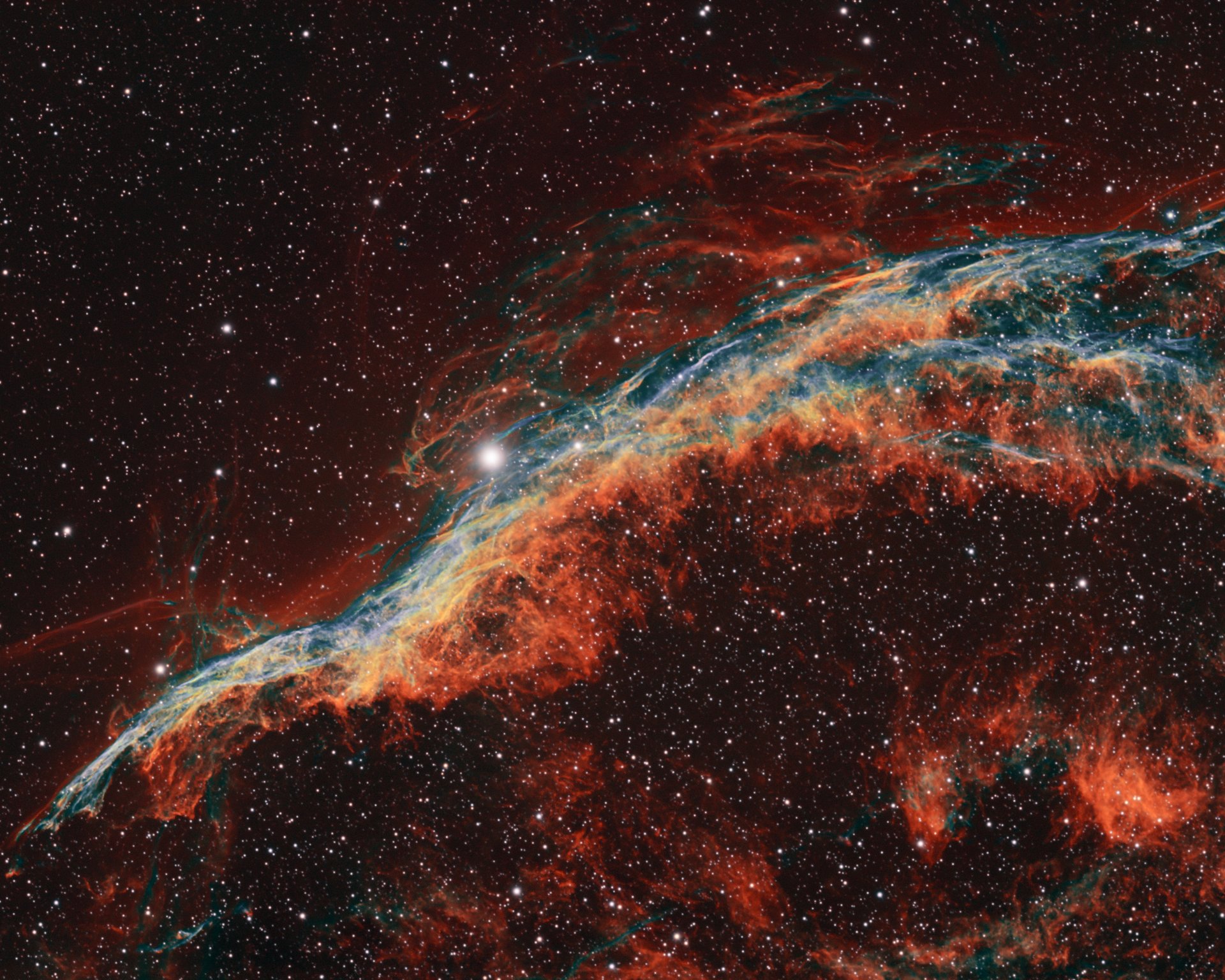
Astrophotograph of the Western Veil Nebula NGC 6960, the Witch's Broom, showing braided cyan doubly ionized oxygen and orange-red hydrogen filaments crossing the bright foreground star 52 Cygni

Witches Broom (Western Veil, NGC 6960)

COSMOS

The westernmost edge of that same Cygnus Loop shot wide-field and shown as separate picture in the gallary but here zoomed into one piece of the shell. That brilliant star blazing right in the middle of the filaments is 52 Cygni, and it's one of astronomy's great optical coincidences: it looks embedded in the wreckage, but it sits at roughly half the distance and has nothing to do with the supernova. It's a foreground star photobombing a 15,000-year-old explosion. You're seeing a shock wave from the side. The braided red-and-cyan ribbon is where the blast wave is slamming into the thin gas between the stars, compressing it into a glowing sheet barely a fraction of a light-year thick. We see it as a sharp filament only because we're looking at that sheet edge-on — like spotting a pane of glass by its edge. The two colors are two temperature zones. Cyan-teal is doubly ionized oxygen ([O III]), marking the hottest, fastest part of the shock front — the leading edge, tens of thousands of degrees. The warm orange-red is hydrogen and [N II] cooling in the wake, where the gas has already been hit and is settling down. Blue is now; red is just after. The braid is a real 3-D structure. Those twisted rope-like strands trace turbulence and instabilities where the shock rips through denser and thinner pockets of gas at slightly different speeds, curling the sheet into filigree. It's still traveling around 170 km/s here and everything you see is the debris of a star that outshone Venus when it exploded.

Artist description

The westernmost edge of that same Cygnus Loop shot wide-field and shown as separate picture in the gallary but here zoomed into one piece of the shell. That brilliant star blazing right in the middle of the filaments is 52 Cygni, and it's one of astronomy's great optical coincidences: it looks embedded in the wreckage, but it sits at roughly half the distance and has nothing to do with the supernova. It's a foreground star photobombing a 15,000-year-old explosion. You're seeing a shock wave from the side. The braided red-and-cyan ribbon is where the blast wave is slamming into the thin gas between the stars, compressing it into a glowing sheet barely a fraction of a light-year thick. We see it as a sharp filament only because we're looking at that sheet edge-on — like spotting a pane of glass by its edge. The two colors are two temperature zones. Cyan-teal is doubly ionized oxygen ([O III]), marking the hottest, fastest part of the shock front — the leading edge, tens of thousands of degrees. The warm orange-red is hydrogen and [N II] cooling in the wake, where the gas has already been hit and is settling down. Blue is now; red is just after. The braid is a real 3-D structure. Those twisted rope-like strands trace turbulence and instabilities where the shock rips through denser and thinner pockets of gas at slightly different speeds, curling the sheet into filigree. It's still traveling around 170 km/s here and everything you see is the debris of a star that outshone Venus when it exploded.