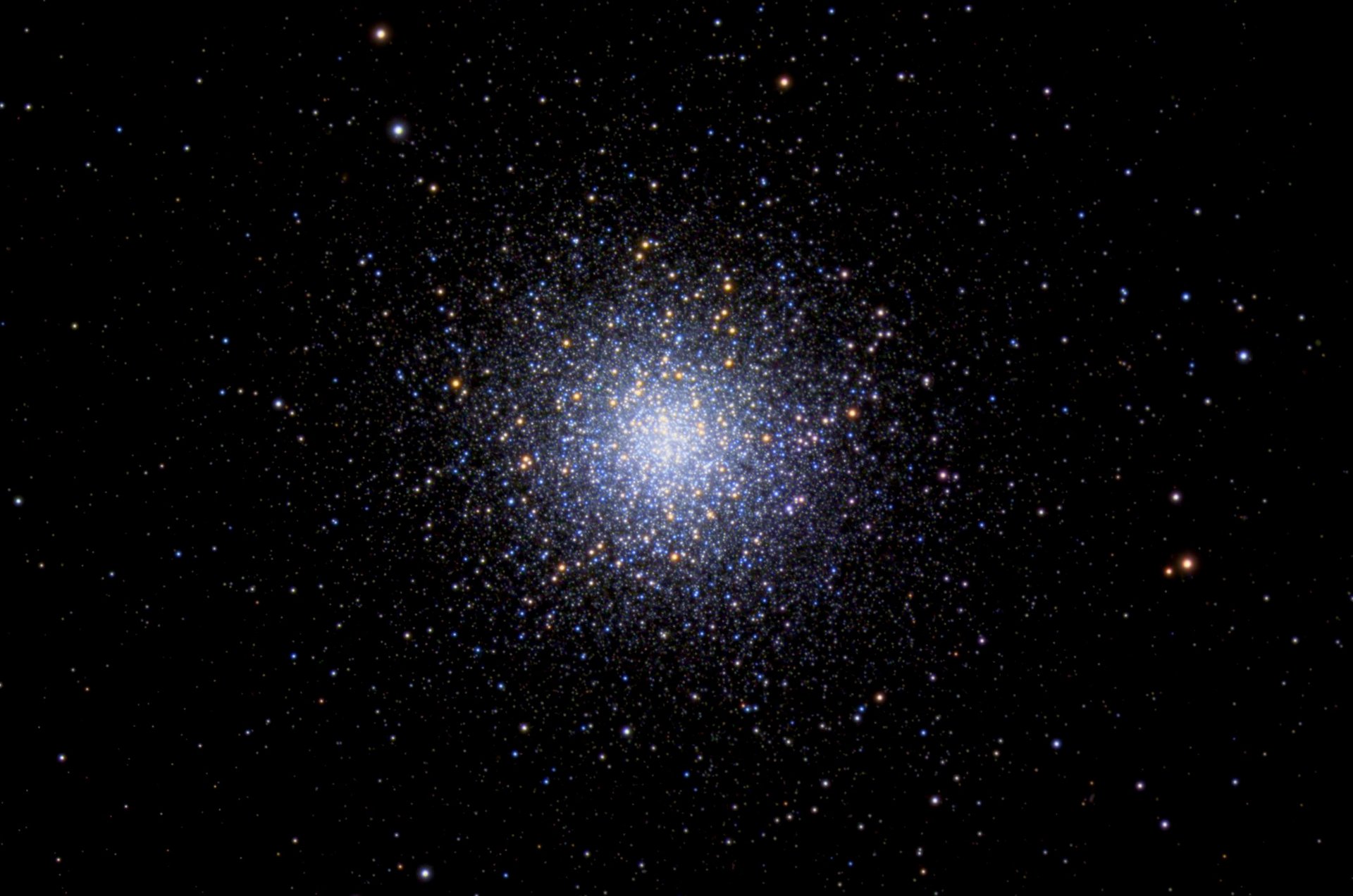
Hercules Globular Cluster (M13)

A stunning view of a globular cluster filled with bright stars against a dark cosmic background.

Hercules Globular Cluster (M13)

COSMOS

One of the most prominent and spectacular globular clusters in the northern celestial hemisphere, M13 is a massive, tightly bound spherical swarm of hundreds of thousands of stars ~22,000 light years away from Earth. Unlike loose, young open clusters (like the Pleiades) which eventually drift apart, M13 is a gravitationally locked system. The mutual gravitational pull of these hundreds of thousands of stars keeps them permanently bound together in a spherical shape as they orbit the center of our galaxy. In the core of M13, stars are packed together thousands of times more densely than the stellar neighborhood surrounding our Sun. M13 is ancient, estimated to be around 11.6 billion years old (almost as old as the universe itself). It formed early in the history of the Milky Way from a single, massive primordial gas cloud, which is why all these stars share a common birth era and localized origin. Because M13 is so old, any high-mass, hot blue stars that formed originally should have long since run out of fuel and died. However, as seen in the photograph, bright blue stars are scattered throughout the cluster, even near the core. These are fascinating anomalies known to astronomers as Blue Stragglers. They likely exist because the stellar density in the core is so extreme that stars occasionally collide and merge, or exist in tight binary pairs where one star gravitationally "sucks" material from its companion. The result of this sudden influx of fresh hydrogen fuel is to re-invigorate the star, making it more massive, hotter, and bluer than it ever should have been at this stage in the cluster's life. The orange and red stars we see now are lower-mass stars (similar to or slightly less massive than our Sun) that have aged into Red Giants. As they exhaust the hydrogen in their cores, they expand and cool down, shifting their peak light emission toward the warmer, red-orange-yellow end of the spectrum.

Artist description

One of the most prominent and spectacular globular clusters in the northern celestial hemisphere, M13 is a massive, tightly bound spherical swarm of hundreds of thousands of stars ~22,000 light years away from Earth. Unlike loose, young open clusters (like the Pleiades) which eventually drift apart, M13 is a gravitationally locked system. The mutual gravitational pull of these hundreds of thousands of stars keeps them permanently bound together in a spherical shape as they orbit the center of our galaxy. In the core of M13, stars are packed together thousands of times more densely than the stellar neighborhood surrounding our Sun. M13 is ancient, estimated to be around 11.6 billion years old (almost as old as the universe itself). It formed early in the history of the Milky Way from a single, massive primordial gas cloud, which is why all these stars share a common birth era and localized origin. Because M13 is so old, any high-mass, hot blue stars that formed originally should have long since run out of fuel and died. However, as seen in the photograph, bright blue stars are scattered throughout the cluster, even near the core. These are fascinating anomalies known to astronomers as Blue Stragglers. They likely exist because the stellar density in the core is so extreme that stars occasionally collide and merge, or exist in tight binary pairs where one star gravitationally "sucks" material from its companion. The result of this sudden influx of fresh hydrogen fuel is to re-invigorate the star, making it more massive, hotter, and bluer than it ever should have been at this stage in the cluster's life. The orange and red stars we see now are lower-mass stars (similar to or slightly less massive than our Sun) that have aged into Red Giants. As they exhaust the hydrogen in their cores, they expand and cool down, shifting their peak light emission toward the warmer, red-orange-yellow end of the spectrum.