Pinwheel Galaxy (M101)

Stunning spiral galaxy with bright core and colorful nebulae in space.

Pinwheel Galaxy (M101)

COSMOS

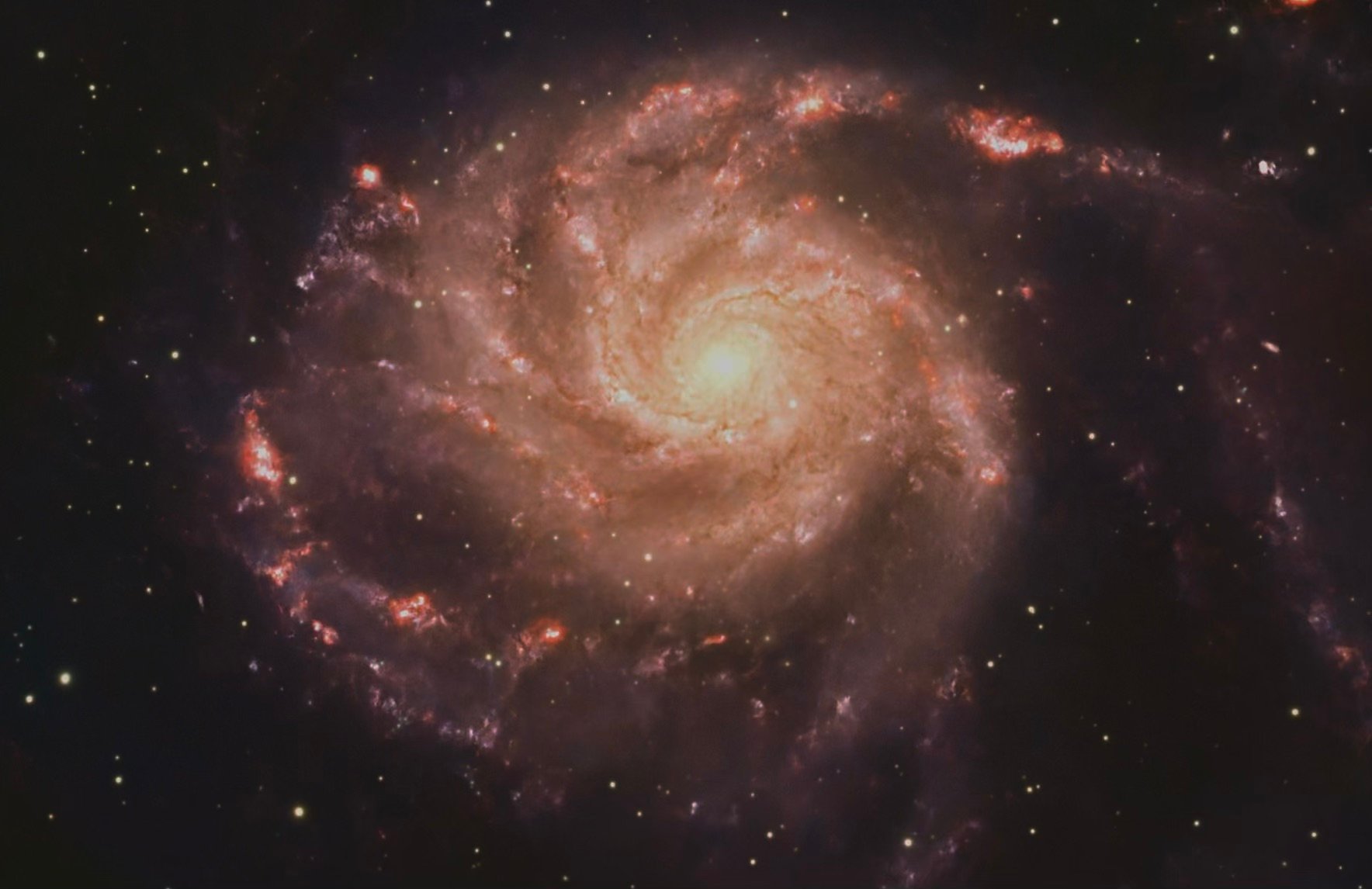
A nearly face-on spiral galaxy in Ursa Major, about 21 million light-years away, and much larger than our Milky Way, with an estimated 1 trillion stars (2-10x compared to the Mily Way) across a disk roughly 170,000 light-years wide (vs Milky Way diameter of 100-120,000 lightyears). The bright, yellowish center consists mainly of billions of older, cooler stars packed tightly together. The brilliant pinkish-red pockets peppered along the spiral arms are gargantuan H II regions—massive nebulae composed of ionized hydrogen gas where furious star formation is actively occurring. Interwoven between the bright stellar arms are cold, dense lanes of cosmic dust (cosmic dust lanes). These block out background starlight and serve as the raw material for future generations of stars. M101 is an active stellar graveyard. It frequently hosts spectacular supernovae. Most notably, in May 2023, an amateur astronomer discovered SN 2023ixf in one of its outer arms (the second bright blob on the arm at the top of the picture). It was a Type II supernova (a collapsing massive star) and became the closest, brightest supernova visible from Earth in nearly a decade. While it looks remarkably grand, M101 is actually highly asymmetrical. If you look closely, the core is visibly offset from the true geometric center, and the spiral arms on one side are stretched out much farther than the other. This distortion is caused by violent gravitational "tug-of-wars" with its smaller satellite companion galaxies. Most large spiral galaxies (including our own Milky Way) anchor themselves around a central supermassive black hole. Surprisingly, intensive X-ray and radio observations of M101 show no evidence of one. Instead, its core seems to host a cluster of much smaller, stellar-mass black holes.

Artist description

A nearly face-on spiral galaxy in Ursa Major, about 21 million light-years away, and much larger than our Milky Way, with an estimated 1 trillion stars (2-10x compared to the Mily Way) across a disk roughly 170,000 light-years wide (vs Milky Way diameter of 100-120,000 lightyears). The bright, yellowish center consists mainly of billions of older, cooler stars packed tightly together. The brilliant pinkish-red pockets peppered along the spiral arms are gargantuan H II regions—massive nebulae composed of ionized hydrogen gas where furious star formation is actively occurring. Interwoven between the bright stellar arms are cold, dense lanes of cosmic dust (cosmic dust lanes). These block out background starlight and serve as the raw material for future generations of stars. M101 is an active stellar graveyard. It frequently hosts spectacular supernovae. Most notably, in May 2023, an amateur astronomer discovered SN 2023ixf in one of its outer arms (the second bright blob on the arm at the top of the picture). It was a Type II supernova (a collapsing massive star) and became the closest, brightest supernova visible from Earth in nearly a decade. While it looks remarkably grand, M101 is actually highly asymmetrical. If you look closely, the core is visibly offset from the true geometric center, and the spiral arms on one side are stretched out much farther than the other. This distortion is caused by violent gravitational "tug-of-wars" with its smaller satellite companion galaxies. Most large spiral galaxies (including our own Milky Way) anchor themselves around a central supermassive black hole. Surprisingly, intensive X-ray and radio observations of M101 show no evidence of one. Instead, its core seems to host a cluster of much smaller, stellar-mass black holes.