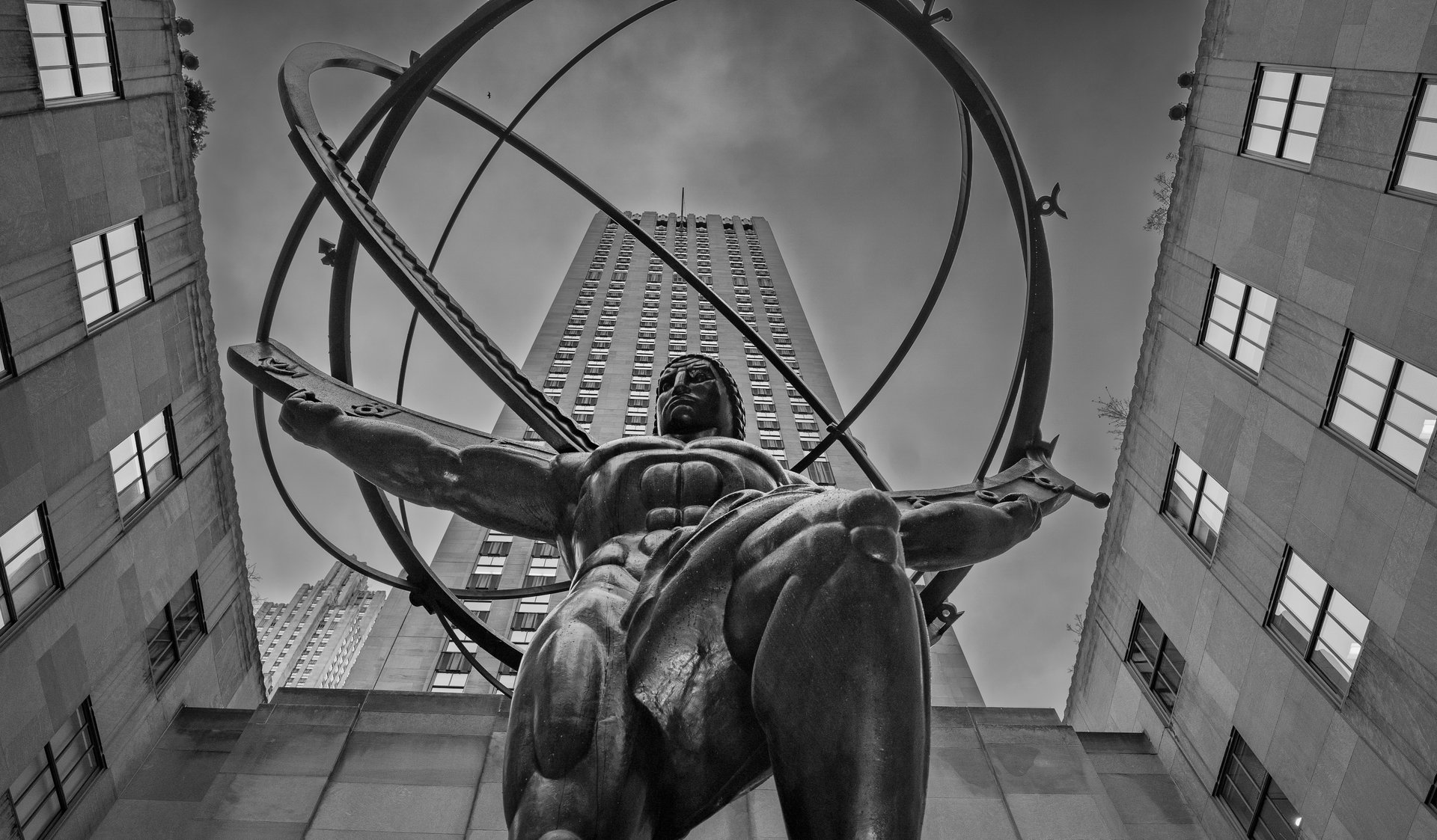
Atlas Statue at Rockefeller Center
EARTH
Atlas isn't a hero — he's a defeated Titan, sentenced by Zeus to hold up the heavens for eternity as penalty for losing a war. The burden isn't chosen; it's imposed. So when Lee Lawrie installed this figure on Fifth Avenue in 1937, in the depths of the Depression, he was doing something more interesting than commissioning a generic strongman. He was placing a condemned god at the entrance to the most ambitious commercial complex in America — a figure whose entire existence is labor without rest, strength without relief. That ambiguity sits inside the image. Is Atlas triumphant, or is he trapped? The photograph doesn't answer. It just makes you ask. The low angle is an argument about scale. Shooting from below the plinth does two things at once. First, it makes Atlas enormous — heroic, monumental, the way civic sculpture is supposed to feel. But second, and more interesting, it puts the viewer in the position of someone crushed beneath him. You're not looking at Atlas; you're looking up at him the way the world he carries would, if the world had eyes. The photograph quietly inverts the usual relationship: instead of Atlas bearing the cosmos, the cosmos (and the viewer) is now bearing witness to him.