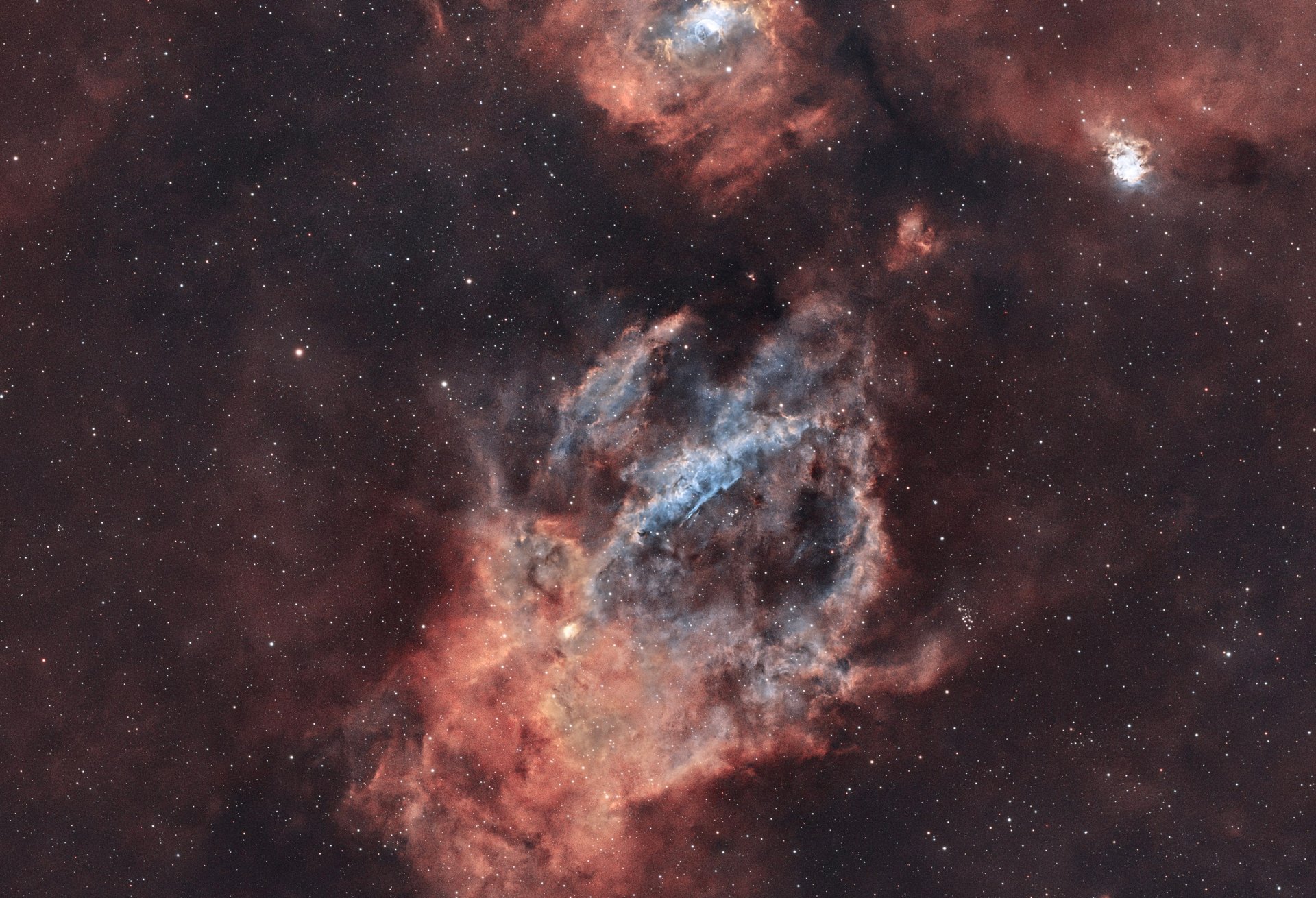
Lobster Claw and Bubble Nebula (Sh2-157)
Astrophotography
The Lobster Claw Nebula (seen in the centre of the photograph) is located in Constellation Cassiopeia and is ~8,000 light-years and is approximately 100 light-years across. The nebula is shaped by the energetic radiation and stellar winds of massive young stars in the nearby open clusters NGC 7510 and Markarian 50. It glows primarily due to ionized hydrogen (H α), giving it its characteristic red hue in astrophotography, with regions rich in oxygen and sulfur adding blue and green tones. The Bubble Nebula (NGC 7635), located at the top centre part of this photo is ~7 light-years in diameter. The Nebula is a spherical emission nebula surrounding the hot, massive O-type star BD +60°2522. The bright star’s powerful stellar wind — a continuous outflow of charged particles — sweeps up the surrounding gas into a glowing shell, creating the bubble shape that gives the nebula its name. The surrounding molecular cloud resists the expansion on one side, making the bubble appear offset and asymmetric. Formation: The Bubble Nebula is a textbook example of stellar wind–driven shaping of interstellar material. Over several hundred thousand years, the O-star’s high-velocity wind (≈1,500 km/s) plowed into the surrounding hydrogen gas, compressing it into a thin, luminous shell. Ultraviolet radiation from the same star ionizes this gas, causing it to emit the distinct H α and [O III] emissions visible in astrophotographs. Eventually, when the central star ends its life as a supernova, it will further disrupt the region and enrich it with heavier elements.