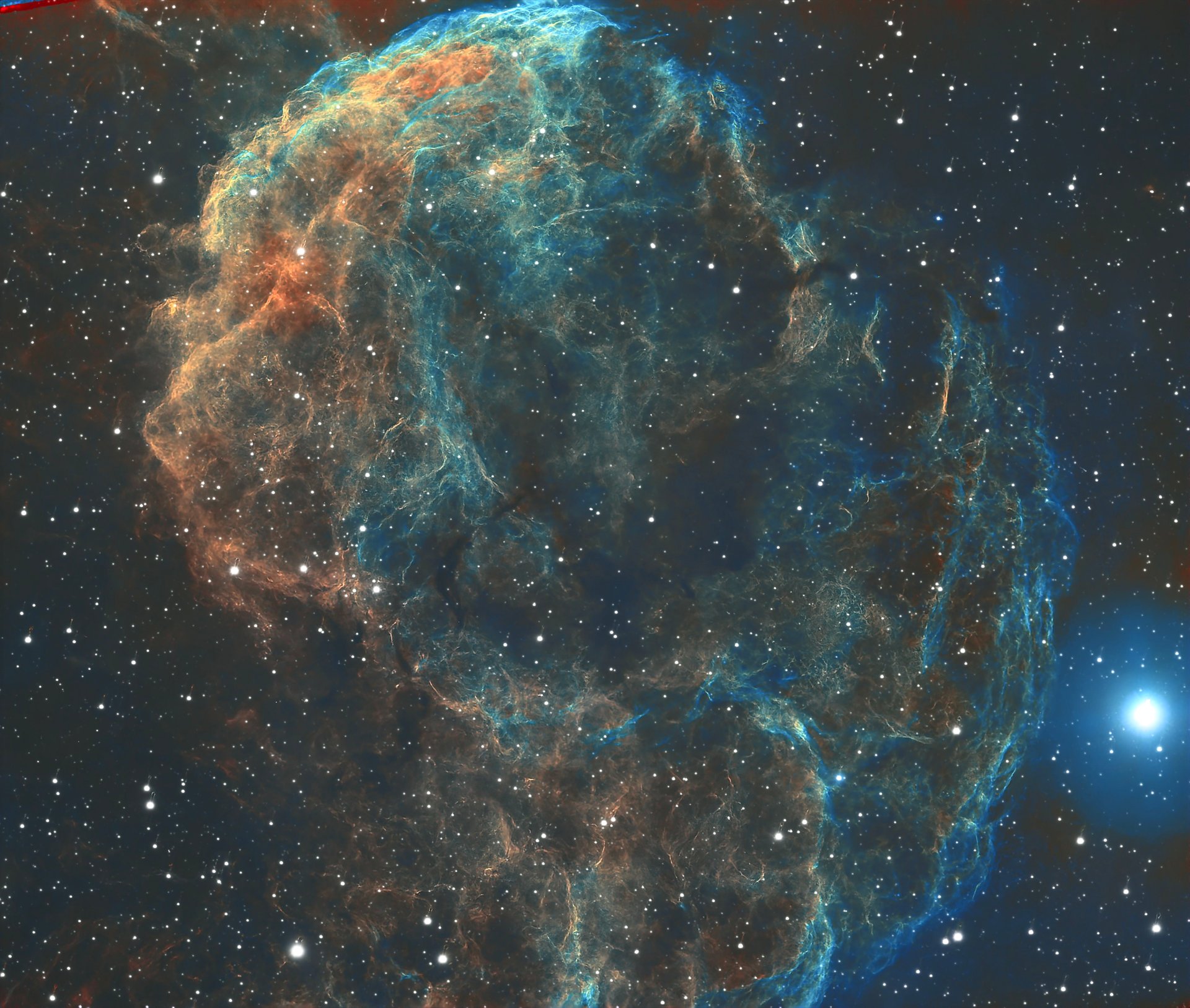
IC 443 (Jellyfish Nebula)
Astrophotography
Approximately 3,000 to 30,000 years ago (the exact timing is still a subject of spirited debate in the journals), a massive star reached the end of its life. When it exhausted its nuclear fuel, its core collapsed, triggering a Type II supernova. What we see today—the "tentacles" of the jellyfish—is the interaction between the expanding blast wave and the surrounding interstellar medium. Unlike many Supernova Remnants (SNR)that expand into empty space, IC 443 is slamming into a dense molecular cloud. This collision slows down the expansion on one side, compressing the gas and causing it to glow brilliantly in hydrogen-alpha and oxygen emissions. Interestingly, in the southern "fringe" of the nebula is a pulsar wind nebula containing a neutron star. This is the crushed, ultra-dense corpse of the original star, spinning rapidly and emitting high-energy X-rays. The neutron star isn't in the center. It appears to be "kicked" away from the explosion site at a velocity of roughly 800,000 km/h. This "supernova kick" happens when the explosion is slightly asymmetrical. The shockwaves of the Jellyfish are so powerful they act as a natural particle accelerator. Astronomers have detected Gamma rays coming from the region, suggesting the nebula is accelerating cosmic rays to nearly the speed of light.