Cygnus Loop

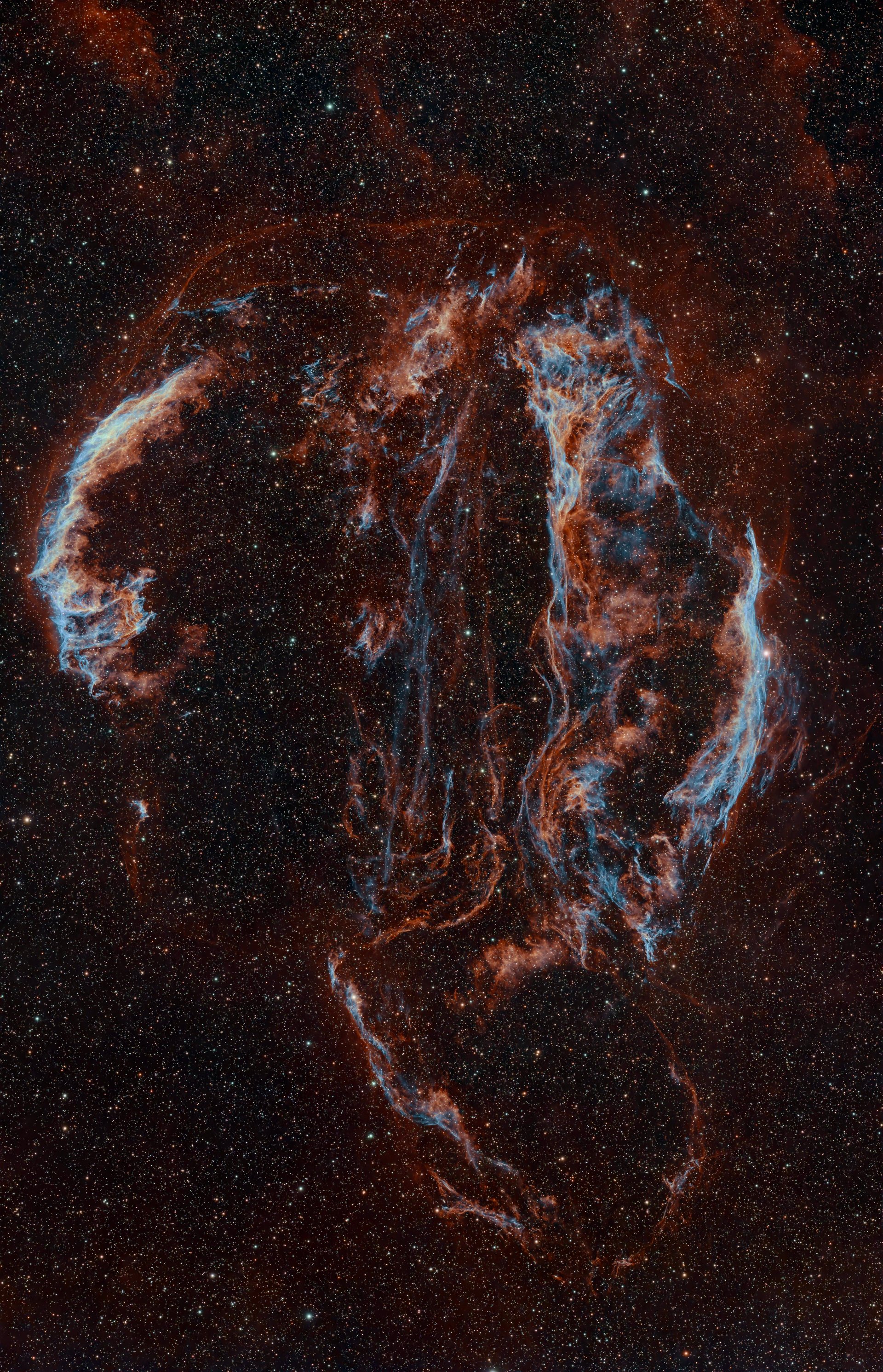
Wide-field astrophotograph of the Cygnus Loop supernova remnant showing NGC 6960, NGC 6992, and Pickering's Triangle in red hydrogen-alpha and blue doubly ionized oxygen filaments against a dense star field.

Cygnus Loop

COSMOS

This is the Cygnus Loop — the full expanding shell of a star that died roughly 10,000–20,000 years ago, about 2,400 light-years away in the constellation Cygnus. The wisps in the middle are an illusion of geometry. The remnant is a hollow, roughly spherical bubble of shocked gas. Where we look through the shell edge-on, the line of sight passes through more glowing material and so the thin sheets stack up into filaments. While deep astrophotographs make it look compact, the Cygnus Loop is visually gargantuan. It spans nearly 3 degrees across on the celestial sphere. To put that into perspective, that is six times the diameter of the full Moon. If our eyes could naturally register this faint emission light, it would dominate a massive portion of the summer night sky The colors are chemistry. The rusty red is hydrogen-alpha, gas recombining behind the shock. The electric blue-white is doubly ionized oxygen, the leading edge of the blast wave, where the shock is still hot enough (tens of thousands of degrees) to strip oxygen atoms twice over. Blue traces where the explosion is happening now; red traces where it has already passed. It's still moving at ~350 km/s which is fast enough to cross the continental U.S. in about 12 seconds and it has already swept up a shell around 120 light-years wide. At its distance, this supernova would have been visible in daylight. It exploded before writing existed.

Artist description

This is the Cygnus Loop — the full expanding shell of a star that died roughly 10,000–20,000 years ago, about 2,400 light-years away in the constellation Cygnus. The wisps in the middle are an illusion of geometry. The remnant is a hollow, roughly spherical bubble of shocked gas. Where we look through the shell edge-on, the line of sight passes through more glowing material and so the thin sheets stack up into filaments. While deep astrophotographs make it look compact, the Cygnus Loop is visually gargantuan. It spans nearly 3 degrees across on the celestial sphere. To put that into perspective, that is six times the diameter of the full Moon. If our eyes could naturally register this faint emission light, it would dominate a massive portion of the summer night sky The colors are chemistry. The rusty red is hydrogen-alpha, gas recombining behind the shock. The electric blue-white is doubly ionized oxygen, the leading edge of the blast wave, where the shock is still hot enough (tens of thousands of degrees) to strip oxygen atoms twice over. Blue traces where the explosion is happening now; red traces where it has already passed. It's still moving at ~350 km/s which is fast enough to cross the continental U.S. in about 12 seconds and it has already swept up a shell around 120 light-years wide. At its distance, this supernova would have been visible in daylight. It exploded before writing existed.