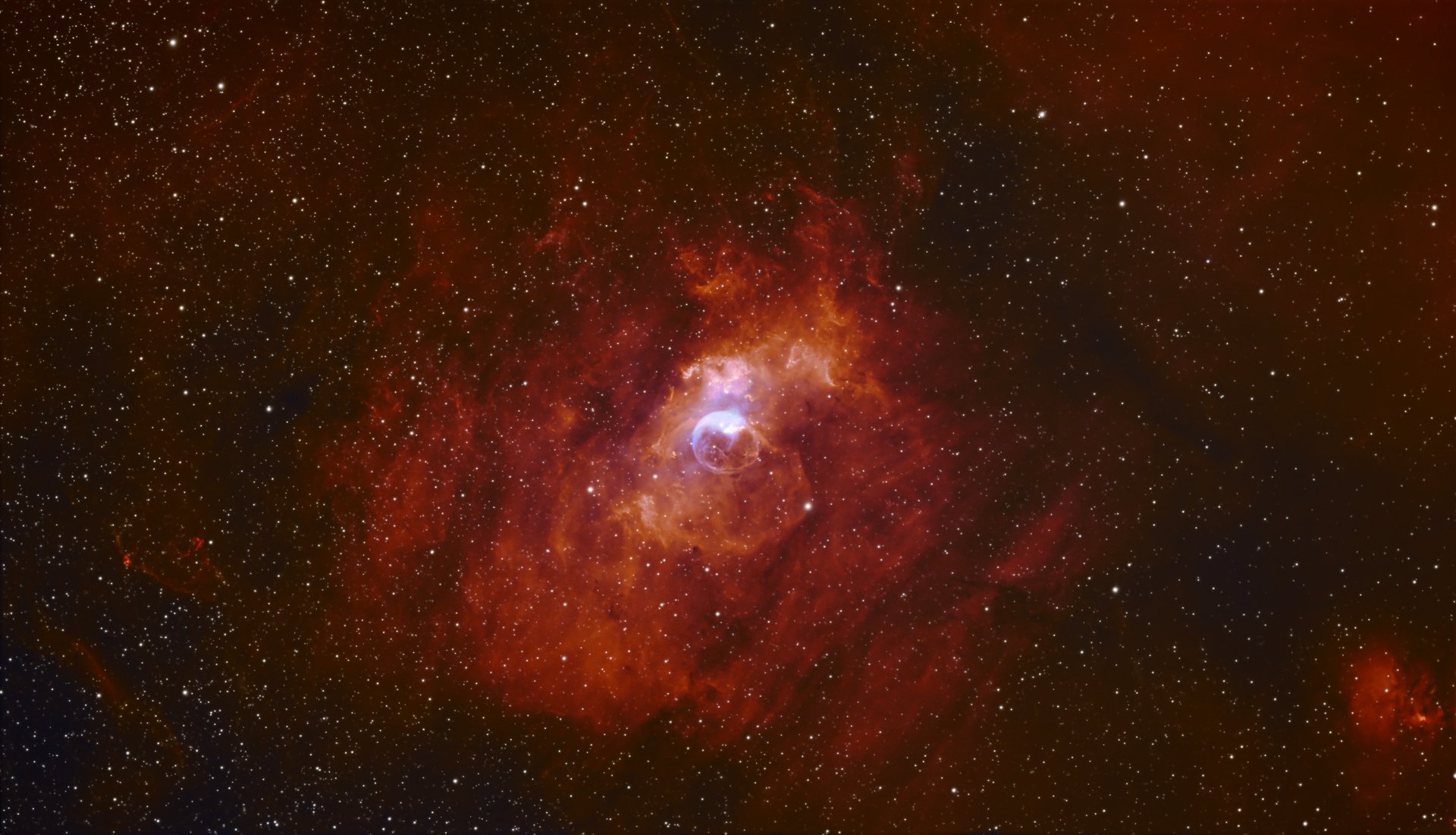
Bubble Nebula (NGC 7635)
COSMOS
The Bubble Nebula, located about 7,000 to 11,000 light-years away in the constellation Cassiopeia, looks like a fragile soap bubble drifting through the void, but the reality is much more violent and impressive. The bubble is being actively created by a massive O-type star called SAO 20575, which is about 45 times more massive than our Sun and hundreds of thousands of times brighter. It emits a fierce "stellar wind" of ionized gas moving at roughly 4 million miles per hour (about 6.4 million km/h). This wind pushes the surrounding cold, interstellar gas outward, forming the translucent shell we see. If you look closely at the nebula, you’ll notice the star creating the bubble isn't in the center. It’s actually tucked away in the upper left. The star itself is moving through space, leaving its "bubble" slightly behind as it travels. While it looks delicate, the scale is hard to wrap your brain around. The bubble is roughly 7 light-years across. For context, the distance from our Sun to the nearest star (Proxima Centauri) is only about 4.2 light-years. You could fit nearly two of our solar systems' "neighborhoods" inside this one bubble. The Bubble Nebula is currently pushing against a massive molecular cloud (the dark, brownish structures seen in high-res photos). As the hot shell of the bubble hits this cold cloud, it causes the gas to glow, creating the complex "ripples" and ridges seen in the picture. Eventually (in a few million years), the central star will run out of fuel and go supernova, likely popping the bubble and scattering all that gas back into the galaxy to form new stars.