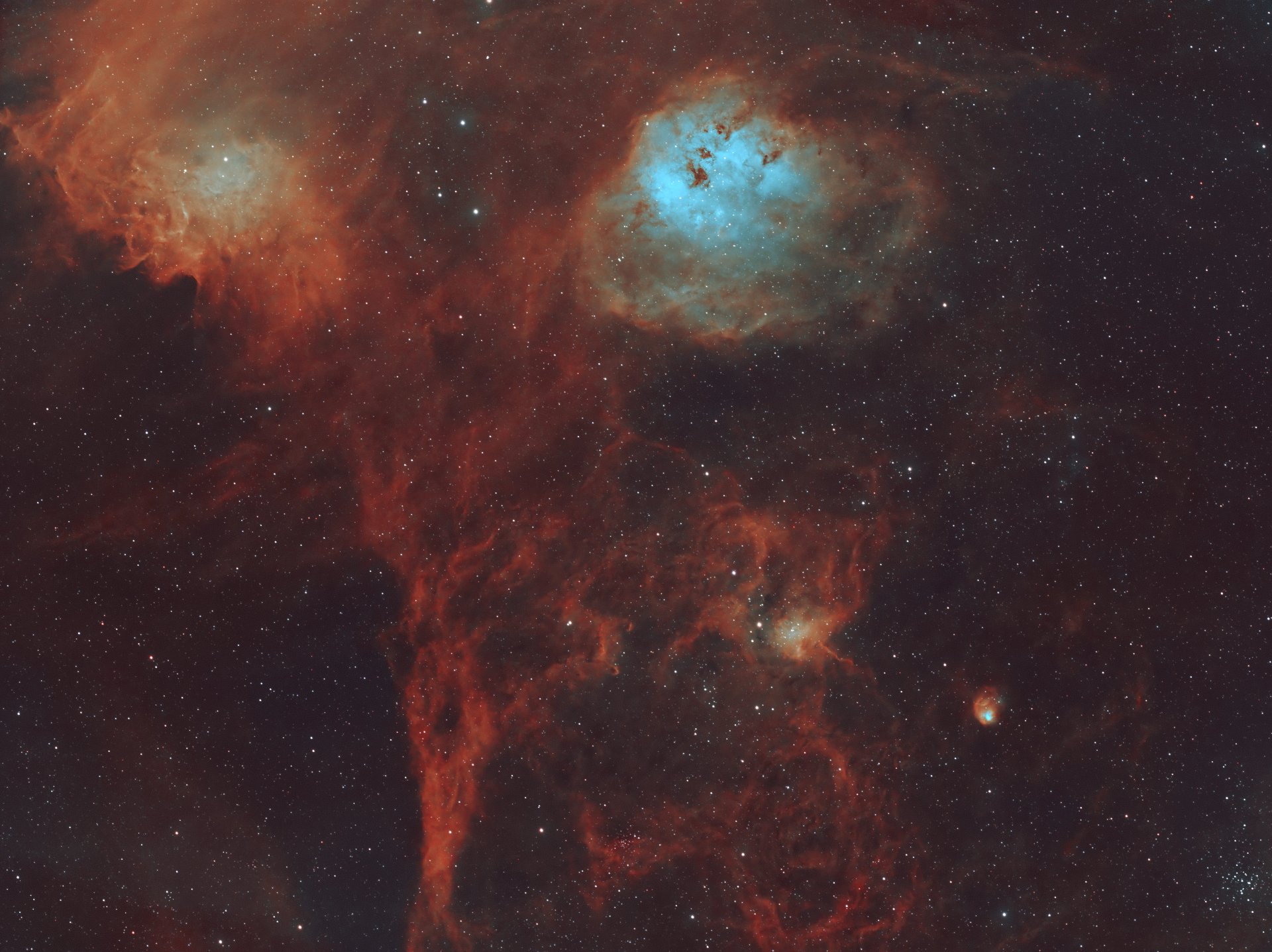
Flaming Star and Tadpole Nebula
Astrophotography
This is a vast region in the constellation Auriga with multiple nebula. The prominant bluish Tadpole Nebula, also known as IC 410, is a large emission nebula located approximately 12,000 light-years away in the constellation Auriga. It is a massive star-forming region, over 100 light-years across, that contains the young open star cluster NGC 1893. The nebula gets its name from two prominent, dense streams of gas and dust that appear as "tadpole" shapes within the glowing cloud.The high-energy UV radiation ionizes the hydrogen gas, causing it to glow in visible light. The nebula to its left is called the Flaming Star Nebula, also known as IC 405 or Caldwell 31. It is an emission and reflection nebula located about 1,500 light-years away . Its distinctive appearance is caused by the hot, blue-white runaway star AE Aurigae passing through a cloud of interstellar gas and dust.Approximately 2.5 million years ago, a close encounter between two binary star systems in the Orion Nebula region ejected AE Aurigae (and another star, Mu Columbae) at a high speed. It is currently traveling through the IC 405 gas cloud at around 200 kilometers per second. The Flaming Star Nebula (IC 405) appears next to the Tadpole Nebula (IC 410) in the sky, but they are at vastly different distances from Earth. The Flaming Star Nebula is about 1,500 light-years away, while the Tadpole Nebula is much farther at approximately 12,000 light-years away. Below these big nebulae is the Spider nebula towards the center right and the fly nebula.