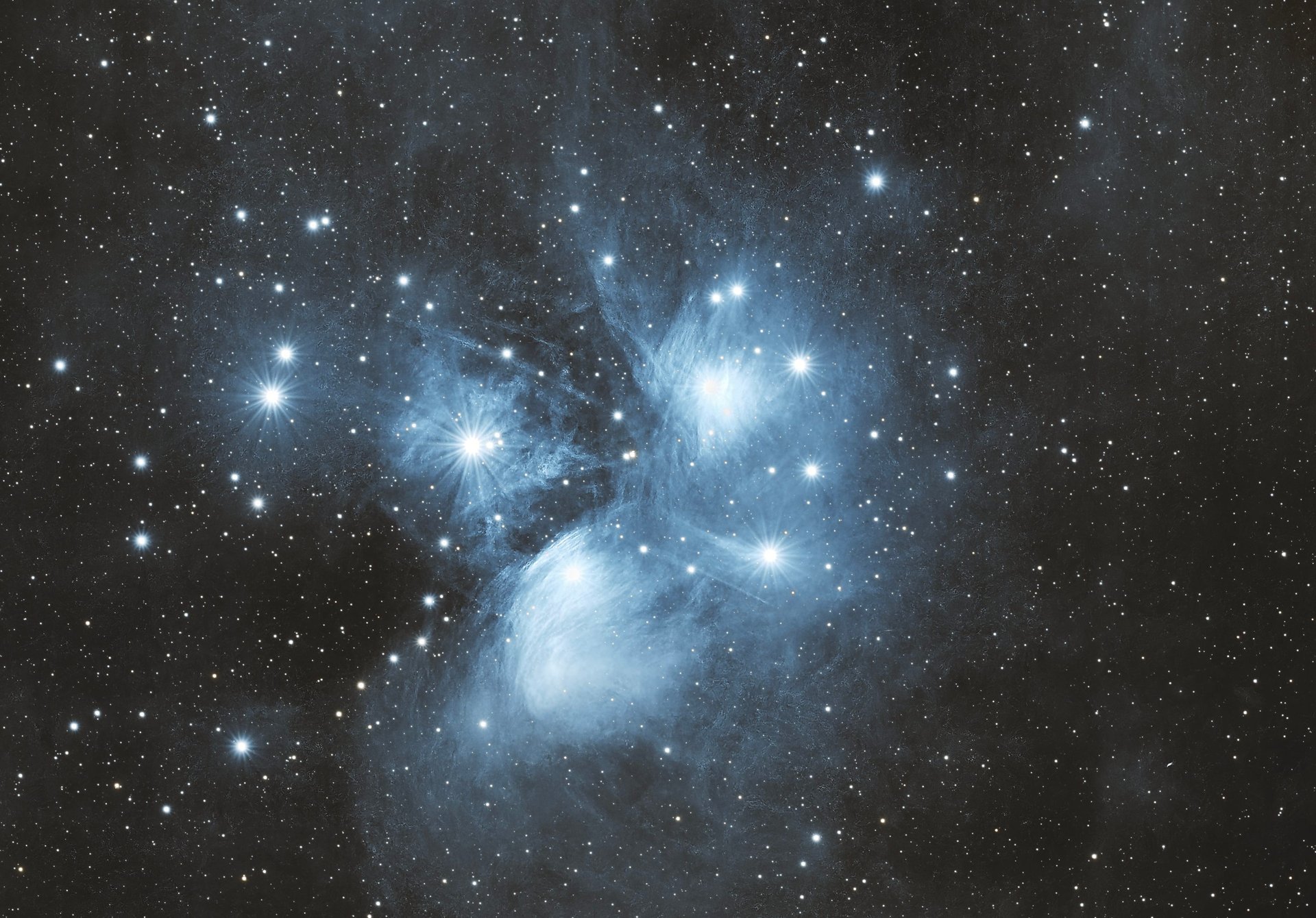
Seven Sisters (M45/Pleiades)
Astrophotography
Messier 45 (M45), popularly known as the Pleiades or the Seven Sisters, is perhaps the most famous open star cluster in the night sky. Located in the constellation Taurus, it is one of the closest star clusters to Earth and has been a cornerstone of human culture, navigation, and timekeeping for millennia. The Pleiades is a "stellar family" of hundreds of stars born from the same cloud of gas and dust. They are relatively young at approximately 100 million years old and sit roughly 444 light-years away.To put that in perspective, they formed during the era of the dinosaurs. In long-exposure photographs like this one (275 x 180s frames), the stars appear wrapped in a blue veil. This is a reflection nebula—a cloud of interstellar dust that the cluster happens to be passing through, reflecting the intense blue light of the hot B-type stars. Many cultures refer to "Seven Sisters" despite only six being easily visible. Astronomers suggest that one of the stars, Pleione, is a variable "shell star" that may have been brighter in the past, or that the stars Atlas and Pleione were once further apart, appearing as two distinct points 100,000 years ago. The Pleiades may be the subject of the oldest story in human history. Because similar "Seven Sisters" myths appear in both Ancient Greece and Indigenous Australia—cultures separated for tens of thousands of years—some researchers believe the story originated in Africa over 100,000 years ago.